# Welcome

Janction is the first Layer2 to provide verifiable, synergic and scalable AI service. Janction uses smart contracts to automate and dynamize machine learning and artificial intelligence. Key elements like AI models, GPU computing power, data feeding, and data labeling all are integrated into Janction for coprocessing.

#### We aim to build a global distributed computing power market, where Janction GPU Marketplace aims to provide unlimited GPU capacity to users at lower costs by aggregating GPUs from multiple sources.

Janction will focus on the core design of the Janction cluster GPU pool and its billing system. First, let's analyze the Janction cluster GPU pool and its billing system. The cluster GPU pool is a system for managing and allocating multiple GPU resources, supporting large-scale parallel computing applications. It needs to consider resource scheduling and management, task scheduling, parallel computing, load balancing, resource security and isolation, fault recovery and fault tolerance, cost management and efficiency optimization, proof of work, and consistency issues, among others.&#x20;


# Introduction

Janction is a scalable web of blockchains that supports distributed artificial intelligence multi-party collaboration and resource sharing. Janction provides comprehensive underlying support for distributed computing systems in areas such as computing power trading, data trading, resource scheduling, verification, consensus, and security. Janction focuses on the artificial intelligence fields that currently have the highest demand for computing power and data. Janction uses smart contracts to automate and dynamize machine learning and artificial intelligence. Key elements such as AI models, GPU computing power, data feeding, and data labeling are all integrated into Janction for co-processing.<br>

We consider how to build such a collaborative system in a distributed trustless way. The following aspects need to be considered:

Resource Scheduling and Management: We need to consider the reasonable and safe allocation of resources such as arithmetic, data, storage, bandwidth, etc. in the system to ensure that the needs of various users and participants are met efficiently, reliably, and equitably, and most importantly, to address the arithmetic routing and cluster mixing section (Colocation).

Data Acquisition: Data acquisition is the process of extracting data from a variety of sources, we can consider a variety of ways to obtain user data from both off-chain and on-chain and give reasonable compensation to data providers.

Proof of Workload: In order to build a truly de-trusted computational network and provide financial incentives for participation, Janction must have a way to verify that the computational work of the AI is indeed performed as promised.

Gaming Mechanism: There are multiple roles in the system participating in the computational tasks, including data providers, data annotators, arithmetic providers, model providers, etc. We need to design a fair and reasonable gaming mechanism that makes it possible to both incentivize the roles in the system to complete the required tasks and maximize the benefits among the roles.

Privacy: At present, countries around the world are paying more and more attention to the protection of personal data privacy, and some countries have already legislated to manage it. We need to address the issues of data segregation, protection of data privacy and security while avoiding data silos during model training and model inference.

Parallelization: Parallelization of deep learning is the most important problem to be solved in the process of AI training, there are already many algorithms in the implementation of neural networks for multi-GPU training, mainly including data parallelism, tensor parallelism and pipeline parallelism, we design a reasonable parallelism, and we need to design a way to communicate in the process of distributed parallel computing.

Currently, distributed AI in academia and industry can only be realized up to model inference, and the architecture of Janction is mainly designed based on model inference.Janction will start from data acquisition, preprocessing, and GPU arithmetic market to gradually realize the AI collaborative Layer2 system.The focus of Janction will be mainly on the core design of Janction cluster GPU pool and its billing system. pool and its billing system core design.Janction Layer2 mainly addresses:

1. designing the way Janction accomplishes data acquisition and pre-processing from both on-chain and off-chain;
2. using microservice architecture to simplify the AI model deployment process by packaging algorithms, system and runtime optimizations and adding standard APIs, containerizing network resources to facilitate system scheduling and management, and providing an end-to-end computational power routing solution on top of that;
3. analyzed the scheme of efficiently scheduling GPU idle arithmetic using the mixing part algorithm and its rationality;
4. designing a GPU arithmetic market, constructing a role model and a gaming mechanism within the Janction system, and pricing the work of arithmetic providers using a workload correlation function with the participants and the VCG mechanism;


# Use Cases

### AI Image Generation

Describe an image using text to generate using AI!

* Designers can work more efficiently
* Advertisers and e-commerce industries can generate high-volume AI-generated content
* Social apps can create AI avatars and wallpapers

<figure><img src="/files/Q6MeNgwnzLYdBx0GFn6C" alt=""><figcaption><p>Write a prompt and generate an image</p></figcaption></figure>

### Speech-to-Text & Text-to-Speech

Write text to generate Speech or \
record audio to generate Text using AI!

* Automated subtitles for video creators
* AI customer service
* Podcast & short video narration with AI-generated voices

<figure><img src="/files/bMAFKagBsLsoSY5IQ3ZC" alt=""><figcaption><p>Write a message to generate as audio or record audio to generate text message</p></figcaption></figure>

### Video Enhancement & Processing

Upload video to enhance using AI!

* Restoring old films using AI super-resolution and upscaling to double the resolution!
* Improving short video quality by removing noise and improving colors
* Apply slow motion and making the video smoother&#x20;

<figure><img src="/files/hQzXo1DoF79zEvv9pNrT" alt=""><figcaption><p>Choose a video to upload and enhance</p></figcaption></figure>

### Object Detection & Image Analysis

Upload images or videos for AI analysis!

* Security surveillance by detecting people in restricted areas
* Automated inspections by industrial defect detection and automatic labeling
* Autonomous driving with real-time object recognition

<figure><img src="/files/HC1VjIQY9mlJJSgUQEy1" alt=""><figcaption><p>Upload a video or image to detect objects</p></figcaption></figure>

### Private LLM - ChatGPT like service

Choose the LLM (ChatGPT like service) AI model you want to run privately!

* Enhanced data security by keeping all the data within internal systems
* Meet regulatory compliance for industries than require localized data processing like Finance, Healthcare and Government
* Reduce the long-term costs as private hosted LLMs can be cheaper to run
* Enable fine-tuning by training the models using your datasets for better accuracy&#x20;
* Optimize the GPU utilization because our GPU resource pooling can efficiently handle LLM inference
* Leverage blockchain technology to ensure security, immutable AI processing and data integrity

<figure><img src="/files/VTxSoj8P7dRb0meihFXq" alt=""><figcaption></figcaption></figure>


# Personas


# Film Production

<figure><img src="/files/nnNPg4JvgSAaqcI0SHFa" alt=""><figcaption></figcaption></figure>

“I’m Alex, a VFX artist who needs a fast and affordable way to render high-quality scenes. Janction helps me deliver stunning visuals on time and within budget.” \
\
💻 My problem? \
I work at a mid-sized post-production studio, and while we have a decent in-house render farm, it’s constantly overloaded. On top of that, cloud rendering services like AWS are insanely expensive, especially when we need to render 4K+ scenes with multiple layers and effects. I’ve had projects where just one sequence took days to render, delaying entire production. Time is money in this industry, and I can’t afford to be stuck waiting. \
\
🚀 That’s why I use Janction.\
With Janction’s on-demand GPU pool, I can instantly scale up my rendering power without breaking the bank. Instead of fighting for resources in the office or overspending on cloud solutions, I just upload my assets, choose the right GPU instance, and let Janction handle the heavy lifting. My team gets results in hours instead of days, keeping projects on schedule and clients happy.\
\
💡 What I love about Janction:\
✅ No more waiting – I get immediate access to high-performance GPUs when I need them. \
✅ Affordable rendering – It’s cheaper than AWS and fits within my studio’s budget.\
✅ Seamless workflow – Works perfectly with Blender, Maya, Houdini, and Unreal Engine.\
✅ Handles big projects – Supports large textures and complex effects without slowdowns.\
\
🎥 Now, I can focus on making jaw-dropping VFX without worrying about hardware limitations. Thanks to Janction, my team delivers top-tier visuals faster and more affordably—and that means more projects, better results, and a competitive edge in the industry.


# Animation Studios

<figure><img src="/files/ORP1OIEgI5aGDRBjUmXb" alt=""><figcaption></figcaption></figure>

“I’m Sofia, an animator bringing stories to life. Janction gives me the rendering power I need—fast, scalable, and affordable.”\
\
🎬 I’m Sofia Martinez, a 32-year-old lead animator based in Madrid. I lead a team of talented artists at MotionFrame Studios, where we create animated films, TV commercials, and special effects for live-action movies. My job is about turning imagination into motion, but there’s one major hurdle—rendering takes forever, and cloud solutions drain our budget.\
\
💻 My problem?\
We work with high-detail 3D models, realistic physics, and complex lighting—all of which demand heavy GPU power. Our in-house render farm can’t keep up with our deadlines, and outsourcing to AWS or Google Cloud costs a fortune. Sometimes, waiting for a single scene to render delays an entire project by days or even weeks. We need a better, more flexible solution.\
\
🚀 That’s why I use Janction.&#x20;

With Janction’s on-demand GPU pool, I get access to high-performance GPUs instantly, without having to buy new hardware or rely on expensive cloud services. Whether we’re rendering character animations, visual effects, or physics simulations, Janction lets us scale GPU resources only when we need them—keeping costs under control while slashing rendering times. \
\
💡 What I love about Janction:&#x20;

✅ No more waiting – My team can render in parallel, finishing projects faster than ever.&#x20;

✅ Budget-friendly – We only pay for what we use, making it cheaper than traditional cloud options.&#x20;

✅ Collaboration made easy – Multiple animators can work on different rendering tasks simultaneously.&#x20;

✅ Seamless software integration – Works perfectly with Blender, Maya, Houdini, and Cinema 4D.&#x20;

🎥 Now, I can focus on storytelling, not rendering delays. Thanks to Janction, my team delivers high-quality animations on time and on budget, without compromising creativity or production speed.&#x20;


# Game Developer

<figure><img src="/files/uZ2N6q9LFB8aoq3E3UfA" alt=""><figcaption></figcaption></figure>

“I’m Jake, a game developer pushing the limits of next-gen graphics. Janction gives me the power to render high-quality assets faster and more affordably.”&#x20;

🎮 I’m Jake Thompson, a 34-year-old senior game developer at Apex Studios in San Francisco. My team is working on our next big AAA title, featuring ultra-realistic environments, ray-traced lighting, and cinematic cutscenes. We want every detail to be perfect, but high-end rendering takes too long, and hardware limitations slow us down.&#x20;

💻 My problem?&#x20;

Game development demands fast iteration cycles—we need to render characters, environments, and cutscenes quickly to test changes in real time. But our RTX 4090 and in-house render farm can’t always keep up, especially during crunch time. We sometimes use AWS or Azure for extra GPU power, but the costs pile up fast, and the setup isn’t always smooth. \
\
🚀 That’s why I use Janction.&#x20;

Janction lets me scale GPU resources instantly without the headache of cloud setup or massive costs. Instead of waiting hours for a high-poly model to render, I can offload the workload to Janction’s GPU pool and get results in minutes. When we need extra power for cinematic cutscenes or real-time ray tracing tests, we just spin up more GPUs on demand—no need to invest in expensive new hardware.&#x20;

💡 What I love about Janction:&#x20;

✅ Faster game asset rendering – I can generate high-detail models & environments quickly.&#x20;

✅ Efficient cinematic rendering – No more waiting forever for high-quality pre-rendered cutscenes.&#x20;

✅ Scalable power for crunch time – Need more GPUs during deadline weeks? No problem.&#x20;

✅ Ray tracing optimization – I can test real-time lighting effects without bottlenecks.&#x20;

✅ Seamless engine integration – Works perfectly with Unreal Engine, Unity, and proprietary engines.&#x20;

🎮 Now, my team can focus on building immersive worlds instead of fighting hardware limitations. With Janction, we develop faster, iterate more, and push the boundaries of next-gen gaming—without breaking the budget.&#x20;


# Industrial Design

<figure><img src="/files/jSty66knv6wrV4kJE6Kh" alt=""><figcaption></figcaption></figure>

“I’m Emma, an industrial designer turning ideas into reality. Janction helps me render high-quality product visuals faster and more affordably.”&#x20;

🏭 I’m Emma Collins, a 38-year-old senior industrial designer based in Munich. At InnovateX, I work on cutting-edge consumer electronics and automotive product design, creating 3D prototypes and photorealistic renders that help bring new products to market. Every detail matters—from material reflections to realistic lighting—but slow rendering delays design iterations and increases costs.&#x20;

💻 My problem?&#x20;

Industrial design is all about speed and precision. I use SolidWorks, KeyShot, and Fusion 360 to create high-resolution visuals for client presentations and product approvals. But rendering a single complex scene can take hours, forcing me to wait before moving on to the next iteration. We occasionally outsource rendering, but third-party services are costly and slow, making collaboration difficult.&#x20;

🚀 That’s why I use Janction.&#x20;

Janction’s on-demand GPU pool gives me the high-performance rendering power I need—whenever I need it. Instead of waiting hours for local rendering or overspending on cloud solutions, I can quickly scale up GPUs, process multiple material variations at once, and finalize product visuals in record time.&#x20;

💡 What I love about Janction:&#x20;

✅ Faster iterations – I can test multiple material finishes and lighting setups in minutes, not hours.&#x20;

✅ Cost-effective rendering – No need for expensive cloud services or new hardware investments.&#x20;

✅ Seamless software integration – Works perfectly with SolidWorks, KeyShot, Blender, and Fusion 360.&#x20;

✅ Scalable & collaborative – My team can render multiple projects simultaneously, keeping workflows smooth.&#x20;

📐 Now, I can focus on refining product designs instead of waiting on renders. Thanks to Janction, my team delivers stunning, high-quality product visuals faster, helping us stay ahead in the fast-paced world of industrial design.&#x20;


# Advertising

<figure><img src="/files/hPlHFfqeuZUloMaTKglj" alt=""><figcaption></figcaption></figure>

“I’m Daniel, a creative director pushing the limits of digital advertising. Janction gives me the rendering power I need—fast, scalable, and cost-effective.”&#x20;

📺 I’m Daniel Reed, a 40-year-old creative director at Visionary Ads in New York. My agency works with global brands to create stunning 3D ads, cinematic commercials, and immersive digital experiences. Our work is all about high-impact visuals, but the biggest challenge is time—clients demand fast turnarounds, and rendering delays can kill a campaign.&#x20;

💻 My problem?&#x20;

We produce 4K and 8K ad content for TV, social media, and digital billboards. My team uses Cinema 4D, Blender, and Redshift Renderer, but even with RTX 6000 workstations, rendering complex animations takes too long. During peak project seasons, we need extra GPU power, but cloud solutions like AWS are expensive and complicated. Clients expect multiple versions of their ads in different formats (landscape, vertical, square, 4K, HD), and the rendering workload adds up fast.&#x20;

🚀 That’s why I use Janction.&#x20;

With Janction’s on-demand GPU pool, I can scale up instantly when I need extra power for high-resolution renders. Instead of waiting days for a single animation to process, I can offload tasks to Janction’s high-performance GPUs and get results in hours. It’s fast, affordable, and seamless, helping me deliver top-tier visuals without blowing my budget.&#x20;

💡 What I love about Janction:&#x20;

✅ Fast rendering – Cuts production time from days to hours, keeping clients happy.&#x20;

✅ Scalable GPU power – I can rent more GPUs on-demand during peak campaign seasons.&#x20;

✅ Seamless integration – Works perfectly with Cinema 4D, After Effects, Blender, and Redshift.&#x20;

✅ High-quality output – Enables 4K, 8K, and multi-format rendering for premium ad campaigns.&#x20;

✅ Budget-friendly – More cost-effective than buying new hardware or using expensive cloud services.&#x20;

🎥 Now, I can focus on delivering breathtaking visuals, not fighting rendering bottlenecks. Thanks to Janction, my team creates high-quality ads at lightning speed, keeping us ahead in the fast-paced world of digital marketing.&#x20;


# AI Image Generation / Text-to-Image

<figure><img src="/files/MQQUTjK9K0dNc8Ff6oj6" alt=""><figcaption></figcaption></figure>

“I’m Rachel, a digital designer creating AI-powered visuals. Janction gives me the speed and scale to generate high-quality images instantly.”&#x20;

🎨 I’m Rachel Lee, a 29-year-old AI-driven designer at PixelCraft Studio in Seoul. My work combines traditional design with AI to create stunning marketing visuals, AI avatars, and concept art for global brands. AI-generated images have transformed the creative industry, but slow processing times and expensive cloud services limit how fast I can work.&#x20;

💻 My problem?&#x20;

Creating high-resolution AI-generated images takes too long on my local RTX 4090. For bulk AI generation, I have to rely on cloud-based services like Stability AI and OpenAI, but the costs are unpredictable and add up fast. Clients expect quick iterations and style adjustments, and I can’t afford to wait for slow renders or be limited by GPU constraints.&#x20;

🚀 That’s why I use Janction.&#x20;

Janction’s on-demand GPU pool gives me the computing power I need, exactly when I need it. Whether I’m generating realistic e-commerce product images, AI avatars, or dynamic marketing backgrounds, I can process high-resolution images in parallel, test multiple styles, and meet deadlines faster—without burning through my budget.&#x20;

💡 What I love about Janction:&#x20;

✅ Faster AI image processing – High-res AI images are generated in seconds instead of minutes.&#x20;

✅ Batch rendering at scale – I can create hundreds of images for campaigns in parallel.&#x20;

✅ Affordable GPU power – More cost-effective than Stability AI, Runway ML, or AWS.&#x20;

✅ Seamless AI model integration – Works with Stable Diffusion, MidJourney, and DALL·E.&#x20;

✅ Supports collaboration – Multiple designers can share GPU resources efficiently.&#x20;

🖌 Now, I can focus on pushing creative boundaries instead of waiting on slow AI generations. Thanks to Janction, my studio delivers eye-catching visuals faster than ever, helping brands stand out in the digital world.&#x20;


# Speech-to-Text & Text-to-Speech

<figure><img src="/files/h6lcROERxNgXuXAY08w4" alt=""><figcaption></figcaption></figure>

“I’m Michael, an AI audio engineer transforming speech into text and voices into lifelike AI narration. Janction gives me the power to process speech faster, cheaper, and at scale.”&#x20;

🎙️ I’m Michael Chen, a 33-year-old AI audio engineer based in Toronto. At VoxMedia, I work on automated speech processing for videos, podcasts, and AI-powered customer service assistants. Whether it’s creating subtitles for YouTube, generating AI voiceovers, or real-time transcriptions, I need high-speed AI inference to keep up with fast-paced media production.&#x20;

💻 My problem?&#x20;

Speech-to-text (STT) and text-to-speech (TTS) models need serious GPU power. Whisper, Tacotron, and WaveNet work well, but my RTX 6000 struggles with large-scale processing. Real-time AI dubbing and multilingual voice synthesis require low latency, and using cloud-based services like AWS Polly or Google Speech API gets too expensive when handling bulk workloads.&#x20;

🚀 That’s why I use Janction.&#x20;

Janction’s on-demand GPU pool gives me access to enterprise-grade GPUs for real-time speech processing, whether I’m automating video subtitles, fine-tuning an AI voice, or transcribing an entire podcast series. Instead of waiting for slow local processing or paying premium cloud prices, I can scale up instantly and process speech at lightning speed.&#x20;

💡 What I love about Janction:&#x20;

✅ Faster speech processing – I can transcribe and synthesize AI voices in real time.&#x20;

✅ Low-latency TTS generation – My AI-generated voices sound natural without delays.&#x20;

✅ Scalability for bulk workloads – When I have large media projects, I just add more GPUs.&#x20;

✅ Cost-effective AI inference – No more expensive cloud API fees.&#x20;

✅ API-friendly automation – Seamlessly integrates with editing and production workflows.&#x20;

🎧 Now, I can focus on delivering high-quality AI-driven speech solutions without bottlenecks. Thanks to Janction, my media team processes speech faster, scales seamlessly, and saves costs on AI-driven audio workflows.&#x20;


# AI Video Enhancement & Processing

<figure><img src="/files/cJzPpUyUBjqwPfqkG1hB" alt=""><figcaption></figcaption></figure>

“I’m David, an AI video engineer bringing old footage back to life. Janction gives me the power to enhance videos faster, at scale, and without breaking the budget.”&#x20;

🎞️ I’m David Kim, a 36-year-old AI video engineer at CineTech Studios in Los Angeles. My job is all about restoring classic films, enhancing digital content, and improving video quality with AI-powered tools. Whether it’s upscaling vintage movies to 8K, reducing noise in low-light footage, or generating ultra-smooth slow motion, my work requires serious GPU horsepower—and that’s a problem.&#x20;

💻 My problem?&#x20;

Processing AI-based video enhancements takes too long on my local workstations. Even with RTX 6000 and A100 GPUs, rendering 4K/8K super-resolution videos, frame interpolation, and AI denoising can take hours per file. Sometimes, we need to process hundreds of video clips at once, and cloud services like AWS and Google Cloud are just too expensive. When working with streaming platforms or film archives, we can’t afford slow turnarounds.&#x20;

🚀 That’s why I use Janction.&#x20;

Janction’s on-demand GPU pool lets me scale up processing power instantly, so I can handle high-resolution AI video enhancement tasks without delays. Instead of waiting hours for AI upscaling or spending thousands on cloud rendering, I can distribute tasks across multiple GPUs, speed up workflows, and meet deadlines effortlessly.&#x20;

💡 What I love about Janction:&#x20;

✅ Lightning-fast AI video enhancement – No more long waits for 4K/8K upscaling and frame interpolation.&#x20;

✅ Batch processing at scale – I can process multiple videos in parallel, keeping my workflow efficient.&#x20;

✅ Cost-effective GPU access – No need for expensive cloud services or additional hardware.&#x20;

✅ Real-time AI inference – Perfect for live video enhancement projects and streaming content.&#x20;

✅ Seamless integration – Works with Topaz Video AI, Super-Resolution GANs, and RIFE models.&#x20;

🎥 Now, I can focus on delivering stunning video quality, without GPU limitations. Thanks to Janction, my team restores classic films, enhances digital media, and creates ultra-smooth slow-motion sequences faster than ever—helping studios and content creators bring high-resolution video to the world.


# AI Object Detection & Image Analysis

<figure><img src="/files/z2lIYkLI4RdtE9gpeq59" alt=""><figcaption></figcaption></figure>

“I’m James, an AI engineer building real-time object detection models. Janction helps me train and deploy vision AI faster, at scale, and without breaking the budget.”&#x20;

🛡 I’m James Carter, a 37-year-old AI computer vision engineer at SecureVision in Austin. My work focuses on developing real-time object detection models for security surveillance, industrial inspections, and autonomous driving systems. Whether it’s identifying security threats, detecting product defects, or improving self-driving perception, my models must process video feeds in real time—without lag or bottlenecks.&#x20;

💻 My problem?&#x20;

Training AI object detection models requires massive datasets and thousands of training iterations. Even with RTX A6000 workstations, it takes weeks to fine-tune YOLO, Faster R-CNN, and SSD models. Real-time inference is even trickier—high-resolution security footage and autonomous vehicle feeds demand ultra-low latency, and cloud GPU costs add up quickly when running 24/7. I need scalable, affordable GPU power that doesn’t compromise speed.&#x20;

🚀 That’s why I use Janction.&#x20;

Janction’s on-demand GPU pool gives me access to enterprise-grade GPUs for training, fine-tuning, and deploying AI-powered object detection models. Instead of waiting days to complete training or paying premium cloud costs, I can scale up instantly, process large datasets in parallel, and deploy models with real-time inference—on budget and on time.&#x20;

💡 What I love about Janction:&#x20;

✅ Faster AI training – Reduces object detection model training from weeks to days.&#x20;

✅ Real-time inference – Low-latency video stream processing for security and automation.&#x20;

✅ Scalable GPU power – Handles large datasets and high-resolution video feeds.&#x20;

✅ Cost-effective solution – More affordable than AWS, Azure, or maintaining in-house GPU clusters.&#x20;

✅ Supports all major vision models – Works seamlessly with YOLOv8, EfficientDet, Faster R-CNN, and OpenCV.&#x20;

🎯 Now, I can focus on building the future of AI-powered surveillance and automation. Thanks to Janction, my team delivers high-performance object detection models faster than ever, ensuring security, safety, and efficiency across industries.&#x20;


# Enterprise LLM API

<figure><img src="/files/60hlnHjN2QJGu4zE8mxK" alt=""><figcaption></figcaption></figure>

“I’m Mark, an AI architect securing enterprise data with private LLMs. Janction helps me deploy compliant, high-performance AI—without cloud risks or high costs.”&#x20;

🏢 I’m Mark Anderson, a 42-year-old Chief AI Architect at SecureMind Analytics in London. My company provides secure, on-premise AI solutions for finance, healthcare, and government organizations—industries where data privacy, compliance, and security are non-negotiable. We need powerful LLMs, but using OpenAI or Google APIs is out of the question due to strict regulations and rising API costs.&#x20;

💻 My problem?&#x20;

Building private, self-hosted LLM APIs is a challenge. Training and fine-tuning models like Llama 3 or Mistral require massive GPU resources, and running real-time inference workloads puts even high-end H100 clusters under strain. At the same time, compliance with GDPR, HIPAA, and financial regulations means we can’t use public AI services. We also need blockchain-backed AI verification to ensure our AI-generated outputs are tamper-proof and auditable.&#x20;

🚀 That’s why I use Janction.&#x20;

Janction’s on-demand GPU pool gives me the compute power I need, when I need it, without investing in expensive in-house hardware. I can fine-tune and deploy private LLMs securely, optimize inference at scale, and integrate blockchain verification—all while ensuring full control over our enterprise data.&#x20;

💡 What I love about Janction:&#x20;

✅ Secure & private AI hosting – My models run on-premise, fully compliant with GDPR, HIPAA, and financial regulations.&#x20;

✅ Cost-effective LLM inference – No more high per-API costs from OpenAI or Anthropic.&#x20;

✅ High-throughput GPU access – I can scale enterprise-grade LLM workloads without bottlenecks.&#x20;

✅ Blockchain-backed AI integrity – Ensures tamper-proof and auditable AI-generated responses.&#x20;

✅ Customizable fine-tuning – I can train models on internal datasets for domain-specific optimization.&#x20;

🔐 Now, I can focus on delivering enterprise AI solutions with confidence. Thanks to Janction, my team builds secure, high-performance LLM APIs without cloud dependencies, compliance risks, or hardware constraints—powering the future of private AI.


# Private Knowledge Base LLM (RAG - Retrieval-Augmented Generation)

<figure><img src="/files/sLhv1PgvNvdR8xknzWog" alt=""><figcaption></figcaption></figure>

“I’m Sarah, an AI knowledge engineer building secure enterprise LLMs. Janction gives me the GPU power to deploy real-time, private knowledge retrieval at scale.”&#x20;

📖 I’m Sarah Williams, a 39-year-old AI knowledge engineer at InfoGuard Solutions in Washington, D.C. My job is to develop private, enterprise-grade LLMs that provide accurate, real-time answers from internal knowledge bases—while ensuring full compliance with GDPR, HIPAA, and SOC 2 regulations. Our clients can’t afford data leaks or reliance on public APIs, so we need secure, high-performance Retrieval-Augmented Generation (RAG) pipelines.&#x20;

💻 My problem?&#x20;

Retrieving accurate answers from massive corporate document databases requires powerful GPUs. Even with A100 and H100 GPUs, running real-time retrieval and inference workloads is resource-intensive. Fine-tuning models like Llama 3, Mistral, and Falcon with company-specific data demands large-scale GPU clusters, and cloud-based hosting is too expensive and poses security risks. To scale efficiently while keeping data private, we need on-demand, enterprise-grade compute power.&#x20;

🚀 That’s why I use Janction.&#x20;

Janction’s scalable GPU pool allows me to fine-tune and deploy private RAG-based LLMs efficiently. Instead of waiting hours for model training or overpaying for cloud AI services, I can securely process massive document sets, optimize enterprise search, and deliver real-time insights—without sacrificing privacy or performance.&#x20;

💡 What I love about Janction:&#x20;

✅ Fast, private enterprise AI – Keeps all document processing on-premise for compliance.&#x20;

✅ Real-time retrieval-augmented search – Enables instant, accurate responses from vast knowledge bases.&#x20;

✅ Scalable GPU inference – Supports high-throughput, low-latency document queries.&#x20;

✅ Affordable LLM hosting – Eliminates the high costs of OpenAI, AWS, or Azure-hosted models.&#x20;

✅ Works with top vector databases – Seamlessly integrates with FAISS, ChromaDB, and Milvus.&#x20;

🔍 Now, I can focus on delivering powerful, enterprise-grade AI search solutions. Thanks to Janction, my team deploys secure, real-time knowledge retrieval systems faster, at scale, and without compliance risks—transforming the way businesses access and use their data.&#x20;


# Family Photographer

<figure><img src="/files/XHcXWo7X7a7OXgKaoITb" alt=""><figcaption></figcaption></figure>

“I’m Mr. Zhang, and I want to bring my old family photos back to life. Janction helps me restore precious memories with AI-powered image enhancement.”&#x20;

📸 I’m Zhang Wei, a 68-year-old retired teacher from Shanghai. Over the years, I’ve collected hundreds of old family photos, many of which have faded, torn, or lost their original colors. Some of them are the only pictures I have of my parents and grandparents. I want to restore these photos and share them with my family, but traditional restoration services are slow and expensive.&#x20;

💻 My problem?&#x20;

I don’t have advanced technical skills, and most photo editing software is too complicated. I tried using mobile apps, but they don’t deliver high-quality results. When I looked intoprofessional restoration services, I found that they take weeks and cost too much per photo. I need a simple and affordable way to enhance my old photos using AI.&#x20;

🚀 That’s why I use Janction.&#x20;

With Janction’s AI-powered photo restoration, I can upload old, damaged photos and get them restored in minutes. The AI removes scratches, enhances details, and colorizes black-and-white images automatically. Now, I can see my family history in a new light—clearer and more vivid than ever before.&#x20;

💡 What I love about Janction:&#x20;

✅ Easy to use – I can restore photos with just a few clicks.&#x20;

✅ Fast results – No need to wait weeks for manual restoration.&#x20;

✅ Affordable – Costs much less than professional restoration services.&#x20;

✅ AI-powered enhancements – Removes scratches, restores colors, and improves details automatically.&#x20;

🖼️ Now, I can share beautifully restored family photos with my children and grandchildren. Thanks to Janction, our family history is no longer locked in faded prints—it’s alive, vibrant, and ready to be passed down for generations.&#x20;


# Indie Game Developer

<figure><img src="/files/cNE9usKuby46NctLuP7z" alt=""><figcaption></figcaption></figure>

“I’m Haruki, a student dreaming of making my own indie game. Janction gives me the GPU power I need—fast, affordable, and easy to use.”&#x20;

🎮 I’m Haruki Tanaka, a 19-year-old university student in Tokyo. Ever since I was a kid, I’ve loved video games, and now I want to create my own indie game. I’ve started learning game development with Unity and Unreal Engine, but I quickly realized that my laptop isn’t powerful enough for 3D rendering, lighting effects, or AI models.&#x20;

💻 My problem?&#x20;

I’m a student, so I don’t have the money to buy a high-end PC or expensive cloud GPUs. My laptop struggles when I try to render detailed character models, test lighting effects, or add AI-driven NPCs. Every time I make changes, I have to wait a long time to see the results, which slows down my progress.&#x20;

🚀 That’s why I use Janction.&#x20;

Janction’s on-demand GPU pool gives me access to powerful GPUs without needing expensive hardware. I can upload my assets, render scenes, and test my game’s performance—all online. It’s affordable, easy to use, and perfect for indie developers like me.&#x20;

💡 What I love about Janction:&#x20;

✅ Fast rendering – I can test changes quickly without waiting for hours.&#x20;

✅ No expensive PC needed – I can use high-end GPUs from my laptop.&#x20;

✅ Easy to access – Just upload my project, select a GPU, and start rendering.&#x20;

✅ Works with Unity & Unreal Engine – Perfect for game development and testing.&#x20;

🎮 Now, I can focus on designing my dream game instead of fighting with slow hardware. Thanks to Janction, I’m one step closer to becoming an indie game developer!&#x20;


# Aspiring 3D Artist

<figure><img src="/files/vAMj3GxavMJ3Kr413RBc" alt=""><figcaption></figcaption></figure>

“I’m Daniel, and I want to learn 3D modeling. Janction gives me the GPU power I need—fast, affordable, and accessible from anywhere.”&#x20;

🖥️ I’m Daniel, a 27-year-old aspiring 3D artist from Nairobi, Kenya. I’ve always been fascinated by 3D animation, game design, and visual effects, and I dream of creating my own characters and environments. But learning 3D modeling requires powerful hardware, and my current computer isn’t fast enough to handle high-resolution rendering.&#x20;

💻 My problem?&#x20;

I’m using Blender and Maya to practice 3D modeling, but my PC struggles with rendering complex scenes. Every time I try to add detailed textures, lighting effects, or physics simulations, my system freezes or crashes. High-end GPUs are too expensive, and cloud rendering services aren’t affordable for beginners like me.&#x20;

🚀 That’s why I use Janction.&#x20;

Janction’s on-demand GPU pool lets me access powerful GPUs without needing to buy expensive hardware. Now, I can render 3D models, experiment with lighting, and create animations much faster—all from my laptop.&#x20;

💡 What I love about Janction:&#x20;

✅ Affordable for beginners – I only pay for what I use, so I can learn 3D modeling without huge upfront costs.&#x20;

✅ Fast rendering – No more waiting hours for a simple model to process.&#x20;

✅ Works on any device – I can use high-performance GPUs from my laptop.&#x20;

✅ Supports Blender, Maya, and more – Perfect for learning and practicing 3D design.&#x20;

🎨 Now, I can focus on learning 3D modeling instead of worrying about hardware limitations. Thanks to Janction, I’m getting closer to my dream of becoming a professional 3D artist!&#x20;


# Playstation Gamer

<figure><img src="/files/46tYhrUmWeEXoOelGZsD" alt=""><figcaption></figcaption></figure>

“I’m Ryan, a PlayStation gamer who loves earning rewards by sharing my GPU power. Janction lets me support cutting-edge projects and get rewarded in JCT.”

🎮 I’m Ryan Mitchell, a 25-year-old gaming enthusiast from Chicago. I spend hours playing on my PlayStation 5, and I know that my console’s GPU sits idle most of the time when I’m not gaming. When I found out I could connect my PlayStation to Janction and contribute my GPU power to AI, gaming, and animation projects, I was excited—it felt like I was part of something bigger.

💻 My problem?

I love gaming, but I’ve always wanted to do something more with my hardware when I’m not playing. Upgrading my setup is expensive, and I don’t always have the money for new games, subscriptions, or accessories. I wanted a way to put my console’s power to good use while getting something in return.

🚀 That’s why I use Janction.

By connecting my PlayStation to Janction’s decentralized GPU network, I can lend my unused GPU power to researchers, developers, and artists around the world. In return, I earn JCT tokens, which I can use for game discounts, PlayStation Store credits, or even trade for real value. Now, every time I’m away from my console, I’m helping indie game developers, AI researchers, and VFX artists bring their projects to life.

💡 What I love about Janction:

✅ Earn rewards for sharing GPU power – My PlayStation isn’t just for gaming anymore.

✅ Support exciting projects – I contribute to AI, animation, and game development.

✅ No extra setup needed – Just connect my PlayStation, and Janction does the rest.

✅ Use my rewards – I can redeem JCT tokens for PlayStation Store credits, games, and more.

🎮 Now, I feel like I’m part of a bigger community of gamers and creators. Thanks to Janction, I’m not just playing games—I’m helping build the future of AI, animation, and indie game development, all while earning rewards.


# Get Started


# Janction Node Operation Graphic Tutorial

[Janction](https://www.janction.io/) is building a service network for the data and computing power sides of artificial intelligence, featuring a fair and efficient revenue distribution algorithm, a data verification layer specifically designed for AI, and an efficient distributed resource allocation system.

<figure><img src="/files/m8pAnM2YppTMUS7V0YDZ" alt=""><figcaption><p>Official website</p></figcaption></figure>

## Environmental Preparation

You can use CPU or GPU servers to run the Janction Node. Using GPU server instances will earn higher points.GPU servers need to install Nvidia drivers, which makes the operation more complicated.The best practice for running a Janction node is to use the Linux operating system.

### For GPU server instances

Create a CPU/GPU server instance and install the Nvidia driver. (If you are using a CPU, skip this step)

<figure><img src="https://q5arfr3cmym.sg.larksuite.com/space/api/box/stream/download/asynccode/?code=YzIxZmVhMTRkN2NmZGI0ODY3ZGE2MjMxOTU1YTgyNjFfdzBhTkI5bGFFeTNqeXdPdGt0OWZNNW15aFFWR201SDVfVG9rZW46TEJjcmI1YWF2b21VWFV4WklzRmxHbkw2Z01oXzE3Mjc0MDUwNTY6MTcyNzQwODY1Nl9WNA" alt=""><figcaption></figcaption></figure>

The above screenshot shows that the server has successfully installed the Nvidia driver.

You can use the `nvidia-smi` command to check whether the driver is installed successfully:

<figure><img src="https://q5arfr3cmym.sg.larksuite.com/space/api/box/stream/download/asynccode/?code=MzdjNDIwYjhlZjVjOTI0Mjg1OGI2ZmU1MjgzODljMzhfVmR0bGF3emxWNnJ0N09TalZ6QjNHWjVhRktybjFLdFVfVG9rZW46Sjc4a2JtQUFKb0FndTB4aVNZVWxzODlDZ2hmXzE3Mjc0MDUwNTY6MTcyNzQwODY1Nl9WNA" alt=""><figcaption></figcaption></figure>

The above screenshot shows the current GPU usage. If you see this interface, the drive is normal.

## Node Operating Environment Preparation

### Installation Environment

<https://www.janction.ai/genesis/deployNode>

#### Macos x86 (eg. I7,I5,I3)

Please install Lima in the terminal to run the Janction node.

```
brew install lima
limactl start
lima sudo -i
curl 'https://www.janction.ai/v0/node/install.sh' |  NODE_ID=5976209f-2a86-4491-8b77-8900a6d10acc bash -s install
```

#### Windows

Please install WSL on Windows first.

{% embed url="<https://learn.microsoft.com/en-us/windows/wsl/install>" %}

If you prefer not to follow the Microsoft WSL guide, you can follow our step-by-step instructions below:

#### Check if WSL is installed

On Windows 10/11, WSL usually comes preinstalled. For earlier Windows versions that don't support WSL, please upgrade your system.

To check whether WSL is already installed (if version info is displayed, it's installed):

```
 wsl.exe --version
```

#### Install Ubuntu

```
 wsl.exe --install --distribution Ubuntu --web-download
```

#### Verify Installation

If you see the following output, it means the node was installed successfully:

```
 wsl.exe --list
```

#### Start Ubuntu and set root password

Launch Ubuntu. The first time you start it, you will be prompted to set a root password. Please remember it.

```
 wsl.exe -d Ubuntu
```

<br>

<figure><img src="https://q5arfr3cmym.sg.larksuite.com/space/api/box/stream/download/asynccode/?code=MjJkYjI5N2I2YTJlYWYzODMyOWRmN2EwN2NhZWU2OTVfTFY4RXN5SkdDNTNBMlNYT0xMcTFtZkpFeVlBQXlEMFBfVG9rZW46Q2lsbGJjamFtb1pJRGF4cDFVN2xSN042Z0tnXzE3Mjc0MDUwNTY6MTcyNzQwODY1Nl9WNA" alt=""><figcaption></figcaption></figure>

## Depoy the Janction node

```
curl 'https://www.janction.ai/v0/node/install.sh' |  NODE_ID=5976209f-2a86-4491-8b77-8900a6d10acc bash -s install
```

If you have any questions, please [contact us](https://x.com/JanctionMGT).


# Related Work

### Distributed Computing

Distributed computing is a computing paradigm that achieves efficient data processing and analysis by decentralizing large-scale computing tasks to different computing nodes. The four currently recognized architectures for distributed computing include Client-Server Architecture, Three-tier Architecture, N-tier Architecture and Peer-to-peer Architecture. Client-server is the most common way of organizing software on distributed systems, the functional components include clients and servers, in fact it is a kind of access processing, the client runs the application and runs the program locally by accessing the server data, which is the way of running almost all the applications nowadays. Client-server architecture offers the advantages of security and ease of ongoing management. Focusing only on protecting the server computer, any changes to the database system require only changes to the server.The Three-tier architecture further divides the server computer into two categories: application servers, which still receive client requests, and database servers, which are the third tier that stores and manages the data, and which are responsible for data retrieval and data consistency.The N-tier architecture includes a number of tiers, including the N-tier model and the N-tier model. The N-tier model includes several different client-server systems that communicate with each other to solve the same problem. Most modern distributed systems use the N-tier architecture, where different enterprise applications work together as one system in the background.Peer-to-peer distributed systems assign equal responsibilities to all networked computers. There is no distinction between client and server computers, and any computer can perform all duties.Peer-to-peer architecture has become popular for content sharing, file streaming, and blockchain networks.

The first three architectures are commonly used in the Internet today, and their flaws are obvious; centralized servers control almost all the data and control the rules of operation of all clients, which is the data and arithmetic monopoly problem we hope to solve. The core of distributed computing is the processing of data. To achieve perfect, efficient and reliable distributed data processing, we first consider Parallelization and Failure resilience, the tasks in Parallelization include data management, task scheduling, load balancing, consistency, communication, etc. Failure resilience needs to consider fault tolerance, recovery, security and privacy, and so on, Failure resilience requires consideration of fault tolerance, recovery, security and privacy, and so on.

The earliest distributed computing solutions date back to the 1970s and 1980s, and although these early systems differed significantly from modern distributed computing, they laid the groundwork for today's technologies, which include Pervasive Computing at Xerox PARC, HTCondor developed at the University of Wisconsin-Madison, Oak Ridge National Laboratory's Parallel Virtual Machine (PVM) developed at Oak Ridge National Laboratory, etc., all of which are still in use today and form the basis of distributed computing systems.

HTCondor is used to deal with high-throughput computing (High Throughput Computing) related problems. Throughput in High Throughput Computing should be the meaning of throughput, that is, the ability to schedule computer resources. the idea of HTC is to split the scale of the intensive operation into a sub-task, to the cluster computers. htcondor provides the following functions:

* Publishing tasks: tasks are published to cluster computers based on set conditions for computing resources within the cluster;
* Scheduling tasks: tasks can be sent to a computer that meets the conditions or migrated to another computer;
* Monitoring tasks: monitor the task running status and computing resources at any time;

HTCondor is currently mainly used for academic experiments, but the subsequent distributed computing computing architecture is also basically in line with the setup of the functional process. the core idea of MapReduce developed by Google is to divide the computing task into two stages: Map stage and Reduce stage, respectively, parallel processing, and scheduling and monitoring by the master. MapReduce is a low-level data processing model, this mode of input jobs can be directly local data sources, if we combine blockchain, the use of consensus algorithms, and the design of a reasonable economic model for task incentives, we can remove the master node dedicated to centralized scheduling and monitoring.

### Microservices and Pooling

Microservices is an architectural style in which the software development process is accomplished using autonomous components that isolate fine-grained business functions and communicate with each other through standardized interfaces.

Traditional application building approaches focus on monolithic architectures. In a monolithic architecture, all functions and services within an application are locked together and operate as a single unit. The architecture becomes more and more complex when the application is added to or improved in any way. This makes it more difficult to optimize any single function in the application without taking apart the entire application. It also means that if one process in the application needs to be extended, then the entire application must be extended as well. In a microservices architecture, each core function in the application runs independently. This allows the development team to build and update new components to meet changing business needs without having to disrupt the entire application.

Microservices are implemented by partitioning business processes into individual services that execute autonomously, and coordinating them into a distributed infrastructure through virtualization technology (typically containerization, such as Docker) to form mutually isolated autonomous units, each with its own processing logic and database. Microservices are currently used in many business environments, and we hope to apply microservices to high concurrency scenarios such as artificial intelligence and blockchain, which can adopt the following three ideas: asynchronous, caching and pooling. Asynchronous processing means that when a program needs to wait for an operation (e.g., I/O operation, network request, etc.) to be completed during execution, it will not block the execution of the current thread, but will continue to execute other tasks until the operation is completed. Caching can reduce the number of accesses to back-end services, such as databases, by storing frequently accessed data in a cache, thus improving the response speed and throughput of the system.

Asynchronous execution and caching is not only a solution for handling high concurrency in microservice architectures, but can be used in any distributed architecture. Pooling in microservice architecture means caching the objects that consume more resources to create, avoiding frequent creation and destruction of objects. This reduces the consumption of system resources and improves system stability and performance. We would like to consider more complex pooling processing in distributed scenarios. In the current context of rapid development of AI and blockchain, the growth in the number of applications has increased the demand for computing resources, many applications will exclusively occupy a single processor during operation, but they only use a small amount of resources, which tends to lead to low processor utilization, and the current major pooling technologies include NIC pooling, storage pooling, memory pooling, CPU pooling, and GPU pooling. We mainly consider GPU pooling in decentralized AI scenarios. GPU-Pooling is a software-defined approach to physical GPUs that incorporates multiple capabilities such as GPU virtualization, multi-card aggregation, remote invocation, and dynamic release, etc. Through the pooling technology, AI applications can invoke GPUs of any size according to the load demand, and can even aggregate GPUs from multiple physical nodes. The number and size of virtual GPUs can be adjusted after the container or virtual machine is created. When the AI application stops, the GPU resources are immediately released and returned to the entire GPU resource pool, realizing efficient resource invocation and full utilization. There are already many mature GPU pooling technologies for production environments, including Nvidia's Remote GPU, Fungible (acquired by Microsoft), which connects GPUs over a network via DPUs and PCI vSwitch, rCUDA developed by the Parallel Architecture Group of the Universidad Politécnica de Valencia, Spain, Bitfusion, acquired by VMware, and Chinese GPU pooling technology. Bitfusion, and OrionX, developed by VirtAITech in China.

### Colocation

In cloud computing, jobs can be categorized into online and offline jobs according to the different computing tasks. Online jobs are usually in the form of services that process user requests and perform computational tasks, such as web search services, online game services, transaction services, AI reasoning services, etc., with high real-time and stability requirements, while offline jobs are usually computationally intensive batch jobs, such as MapReduce, Spark jobs, AI training, etc. Mixing online and offline jobs in the same cluster is called Colocation. Deploying a mix of online and offline jobs in the same cluster is called Colocation. online jobs are real-time, delay-sensitive, and have low resource consumption, while offline jobs are delay-insensitive and have high resource consumption. what Colocation needs to do is to populate the offline jobs to utilize the free resources of the online services in each time slot, and when the online jobs need resources, the offline jobs will return the occupied resources in time. When the online job needs resources, the offline job returns the occupied resources in a timely manner, and the operation of the offline job tasks can not cause significant interference to the online job tasks. Overall, the most important goal of Colocation is to maximize the utilization of single-computer resources while guaranteeing the SLA (Service Level Agreement) of online services and offline jobs.


# Architecture

<figure><img src="/files/w4mpPOjkSSLOOomuIWMg" alt=""><figcaption></figcaption></figure>

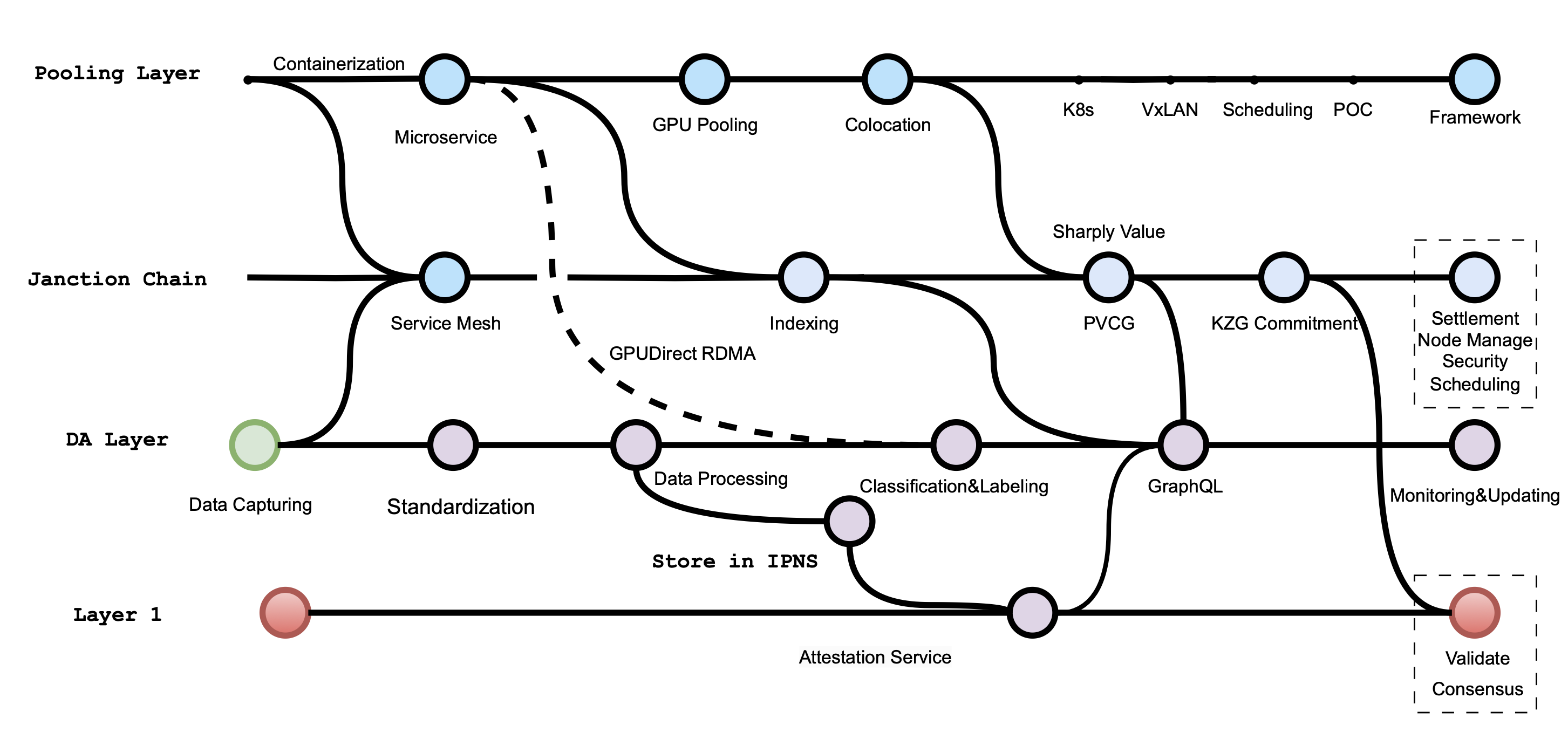
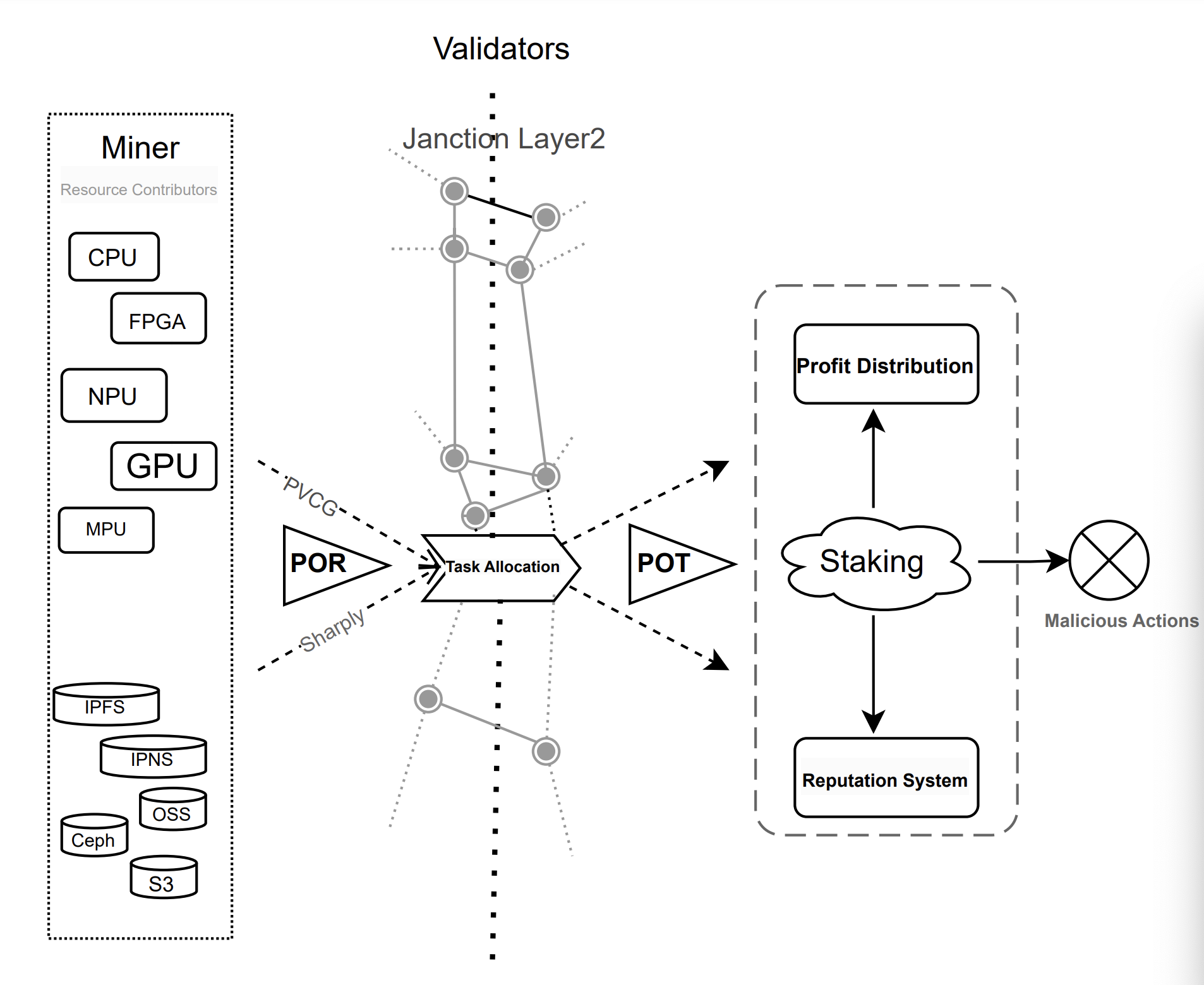
The architecture of Janction mainly contains three parts Blockchain Layer, Distributed pooling of resources and GPU Marketplace.Blockchain Layer, as the settlement layer and DA layer of the distributed AI system, is mainly responsible for content data storage, transaction information storage and reward distribution. In the blockchain layer, data acquisition is done through browser extension crawling and on-chain data ingestion. Users can crawl their browsing data through Janction Extension, including Chatgpt question data, search engine browsing data, social APP data, etc., and then upload them to Janction Extension after user signature. Janction layer2 is mainly responsible for verifying the transaction process in the system and uploading it to the chain to record, the automatically running Proof of Contribution consensus algorithm will prove the contribution of the participants in the system and allocate rewards to the participants based on the contribution degree, and all the transaction processes in the chain are stored in the Data Availability layer. All transactions on the chain are stored in the Data Availability layer.

The core business processing part of Janction is Distributed pooling of resources, which pools GPU resources shared by users, and different types of GPUs are divided into vGPUs, each of which has equal arithmetic power and video memory, and are containerized to build a microservices architecture, which is composed of GPU pools through VxLan. The GPU pool is formed by VxLan, and when users need to use GPU resources, they will be allocated GPU resources through appropriate arithmetic routing and scheduling algorithms, and the rental behavior is priced by the PVCG mechanism.The AI microservice containers interoperate with each other through RESTful APIs, and Janction provides service api in the back-end to provide services for the users.

GPU marketplace is the front-end and back-end part of Janction system, which provides user personal information management, node management, service monitoring, system report and other services, including user reputation system in the user information, so as to evaluate the value of resources provided by the user and prevent malicious behavior.


# Actor Model

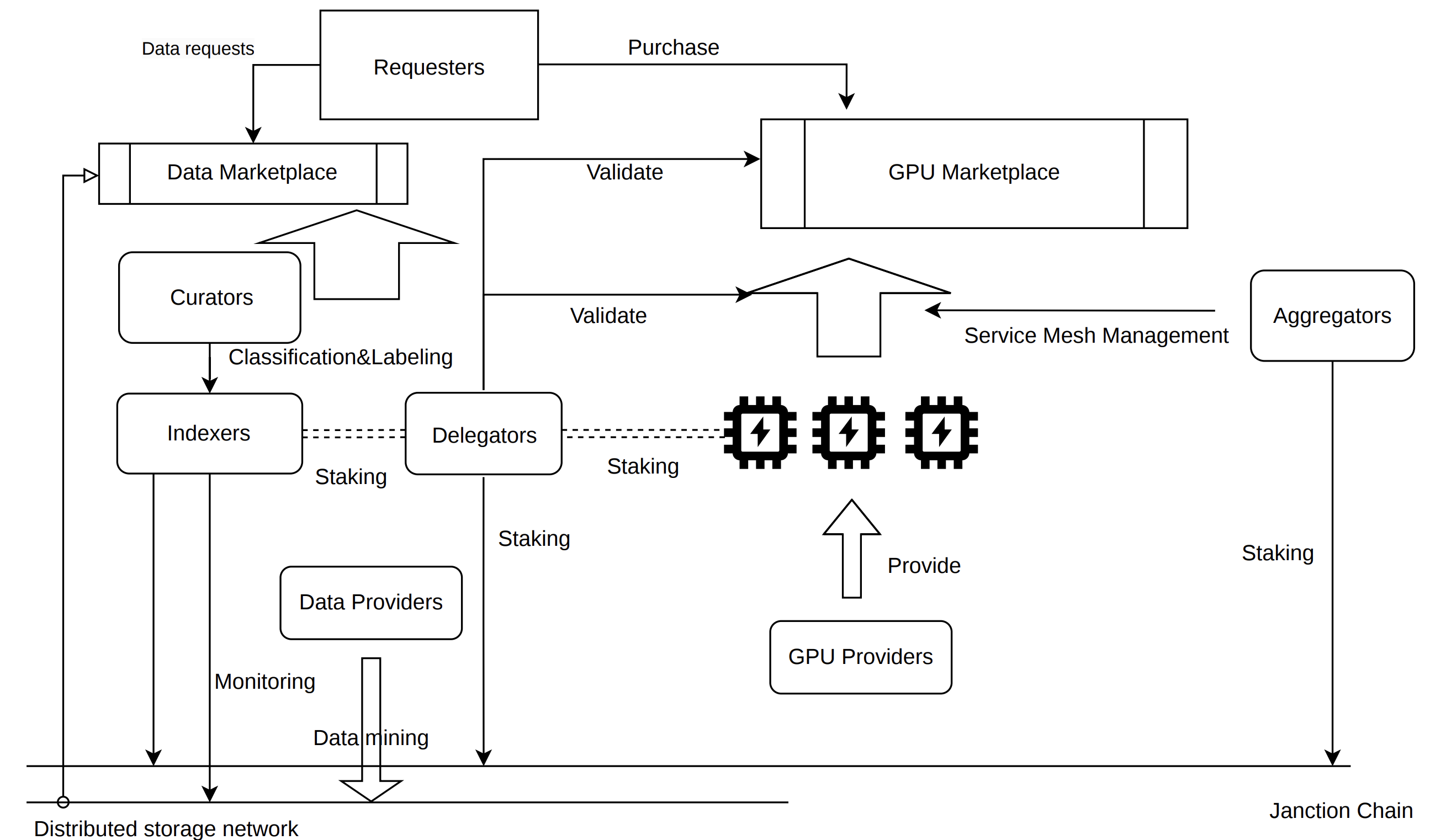
The main components within the Janction system are the GPU Provider, Aggregator, User, and node participants.The GPU Provider generates revenue by providing GPU and other processor resources.The Aggregator is a Service Mesh participant that participates in the down-the-chain execution portion of the resource pool creation process, and operates and maintains node Discover and manage GPU resources.User is the arithmetic user, procuring GPU resources in the system and using janction's services. All roles can be node participants in the Janction Network. Node participants can Staking on Janction Blockchain, participate in verifying and supervising every process of the system operation, and can also Staking on GPU resources, and the greater the Staking value the greater the weight of the revenue allocation in the revenue calculation of GPU resources.The Aggregator is elected by the Staking participants on the chain. The Aggregator is elected by the chain Staking participants.

<figure><img src="/files/J4Q7jRtitEght1tT4NKV" alt=""><figcaption></figcaption></figure>

All users of Janction ecosystem products and APIs can become Data Providers for the Janction Network. The data generated by users may be stored in Janction distributed storage network. after permission control and data processing. Indexers are responsible for monitoring changes in data sources within the Janction Network and providing data indexing and query services for the system. Curators will perform secondary processing on the data captured by Indexers, mainly involving data preprocessing for machine learning, including classification and labeling, to facilitate Requesters in quickly selecting and using the data. At the same time, Curators will also propose valuable data to Indexers based on feedback from Requesters. Delegators can also play a similar role in this process.


# Pooling

<figure><img src="/files/fzNrLVt9woCyAWZHgx2Q" alt="Distributed pooling of resources"><figcaption><p>Distributed pooling of resources</p></figcaption></figure>

Janction does this by integrating deep learning or other compute services into tools that support a microservices architecture, where each function is executed in a separate container (Docker, for example). We start with a simple virtualization of GPU arithmetic resources for use by different container applications, which involves splitting the physical GPU into multiple fixed-size vGPUs, each with equal arithmetic and graphics memory. It has been proven that different AI models have different requirements for computing power and graphics memory resources. Therefore, such a slicing approach does not meet the diverse needs of AI models.GPU virtualization is mainly Time-slicing, Multi-Process Service, Multi-Instance GPU, etc.&#x20;

Time-slicing uses a simple oversubscription strategy to invoke the time-slice scheduler of GPUs. Time-slicing uses a simple oversubscription policy to invoke the GPU's time-slice scheduler to achieve concurrent execution of multiple CUDA applications through GPU time sharing; Multi-Process Service is an alternative binary-compatible implementation of the CUDA Application Programming Interface (APPI) that allows multiple streams or CPU processes to make CUDA Kernel calls to the GPU at the same time, combining them into a single The Multi-Instance GPU feature (starting with the NVIDIA Ampere architecture) allows the GPU to be securely partitioned into up to seven separate GPU instances, partitioning the system's available GPU compute resources (including stream multiprocessors, SMs, GPU engines, and so on) to provide the ability for different clients (e.g., virtual machines, containers, or processes) to run their applications in a single GPU. The GPUs are partitioned into up to seven separate instances of the system's available GPU compute resources (including streaming multiprocessors, SMs, GPU engines, etc.), providing quality assurance with fault isolation for different clients such as virtual machines, containers, or processes.

Each microservice interoperates with other microservices in a lightweight and loosely coupled way via RESTful APIs. Janction provides Serverless container batch management and scheduling interfaces as the backend of the entire distributed AI service, and these interfaces automatically manage the allocation of resources as well as storage and bandwidth in the GPU market in real-time. Then Janction builds cross-cluster arithmetic service routing protocols based on VxLAN, and applies appropriate scheduling policies (Gang-scheduling, Fair-share scheduling, DRF scheduling) in the distributed GPU arithmetic network to complete the entire microservice-based implementation of the Serverless Distributed pooling of resources system.

In Janction's GPU pooling design, Janction Network serves as the Service Mesh for the pooling process and is mainly responsible for managing scheduling, monitoring, and system security. Each GPU resource pool is created by deploying a Controller contract on Janction Network, which mainly accomplishes service registration and service discovery of each functional component, scheduling allocation of vGPUs, metadata storage and management, and License management. These contract tasks will not be completely completed on the chain, and may be executed off-chain by calling the SDK. physical machines provided to the GPU contributor are virtualized through the CUDA Driver and Janction network, and managed using Docker. Arithmetic resource renters use vGPU resources by calling the Janction Server API, and the process builds virtual routes for arithmetic resources based on VxLAN.The Janction Server API wraps the Client Runtime and surrounding ecolibraries such as cudart, cublas, cudnn, cufft, cusparse, for developing parallel computing task programs, and additionally, the Janction Server API provides users with functions such as requesting, releasing, managing, and monitoring GPU resources. Then under the application of task execution is the framework layer, which is tensorflow, pytorch, paddle, etc. commonly used in AI training and reasoning. For system data input, we designed Data Plane, which is mainly composed of distributed storage and Memory, and the physical machine communicates with Data Plane directly through GPUDirect RDMA.GPUDirect with RDMA enables communication between GPUs and other devices (e.g., network adapters, storage systems, and other GPUs) with direct memory access between GPUs and other devices such as network adapters, storage systems, and other GPUs. It allows data to be transferred efficiently without CPU involvement, thus reducing latency and increasing bandwidth.


# Token

## Janction Testnet

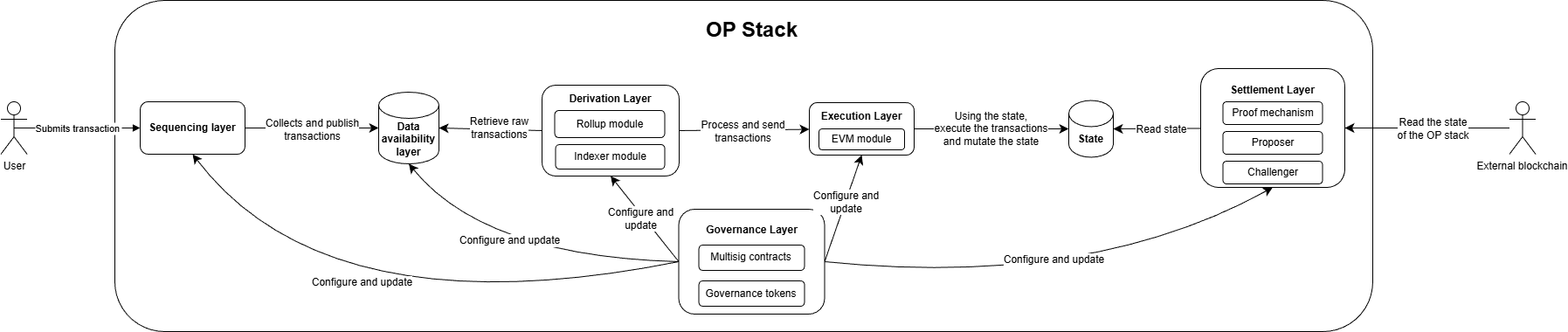
Janction testnet is now live! The ID of the chain is 679 and can be easily found here: [https://chainid.network/chain/679](https://chainid.network/chain/679/). The system is developed using Optimism's OP stack. The OP stack is a popular system for creating new L2 blockchains, meaning production-quality Optimistic Rollup blockchain, which fits very well with Janction's goal. The testnet is using Sepolia's Testnet as the Settlement Layer with chain id: 11155111.

<figure><img src="/files/oME05W3I1dHyb8WZPN9s" alt=""><figcaption><p>OP stack architecture diagram</p></figcaption></figure>

The links to the WS and HTTP respectively are:

* wss\://janction-testnet.alt.technology/ws
* <https://janction-testnet.alt.technology>

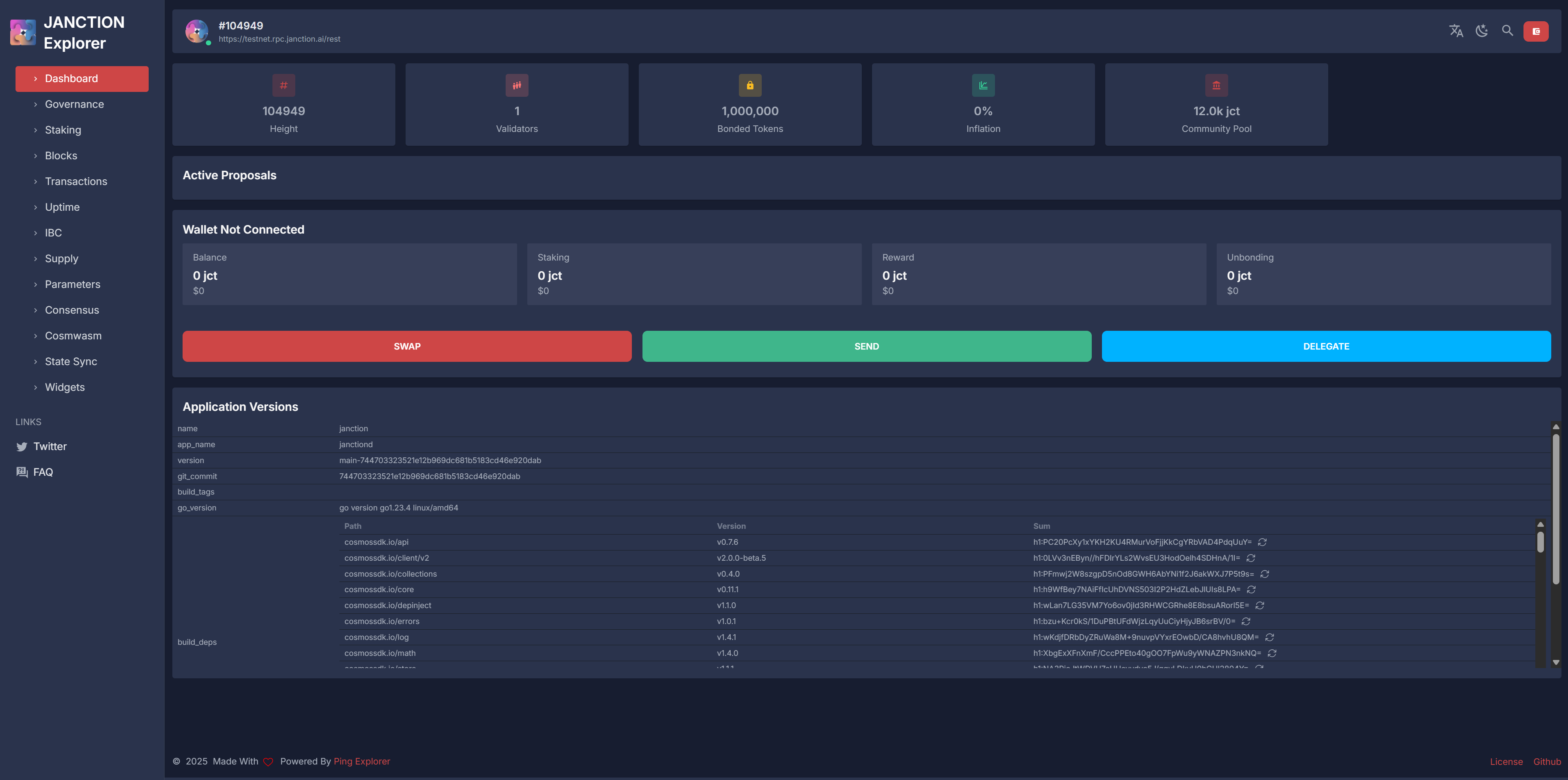
Please use the explorer of the Janction testnet in order to see live statistics of the running testnet as well as see and search blocks and transactions. Link is here: <https://janction-testnet-explorer.alt.technology.>

Some additional information about the node:

* op-node is version 1.10.3
* op-geth is version 1.101411.6
* l1-op-contracts is version 1.8.0-rc.4
* l2-op-contracts is version 1.7.0-beta.1+l2-contracts
* genesis file can be found here: <https://operator-public.s3.us-west-2.amazonaws.com/janction/testnet/genesis.json>
* rollup config can be found here: <https://operator-public.s3.us-west-2.amazonaws.com/janction/testnet/rollup.json><br>

### Bridge application

We offer a bridge application here: <https://bridge.janction.ai/>\
This application is used to send tokens from Sepolia Testnet to Janction Testnet or the opposite. This is useful if you want to start using the Janction Testnet and you have to send some tokens in order to use it.

<figure><img src="/files/BeHAjiWhCaAWmpNjwhRs" alt=""><figcaption><p>Bridge app walkaround GIF</p></figcaption></figure>

1. First, connect your wallet by using the "connect" button at the top right corner. Now, you can connect any wallet you want from the list. After connecting your wallet, you will see the two new buttons at the top right corner have appeared. The first button is to switch to a different networks and the second button is your wallet.
2. Now, we have to pick the source and the target networks, "From" and "To" respectively. We basically have two options:

   1. Either send ETH from Sepolia Testnet to the Janction Testnet. This is the default one, as users typically have Sepolia ETH that they want to use inside the Janction Testnet.
   2. Send tokens from the Janction Testnetto the Sepolia Testnet.

   To change between the two options, you can use the "From" or "To" buttons. These buttons will switch your preference.
3. Then, we have to enter the amount of tokens we want to transfer. For the present, the only available token is ETH, but in the future, we could have another token to transfer between the networks. Keep in mind that the app conveniently tells us how much of the selected token type we have available in our wallet to transfer. After adding the amount that we want to transfer we will see two things:
   1. A new bubble appears that shows us information about the transfer we picked. This information is a summary of the transfer as well as some extra information like the gas fee needed and the estimated amount of time for the transaction to be completed.
   2. The main button changes to reflect the action that we can do. If we have sufficient funds in our wallet, then the button is changed to black color and says "Review bridge". Otherwise, the button is gray with the text "Insufficient funds", indicating that we cannot make the transfer because we don't have the necessary tokens in our wallet. If that is the case, either pick a smaller amount or add more tokens to your wallet in order to finish the transaction.
4. (OPTIONAL) The "gear" button is the "settings" of the app in order to change your preferences.
5. (OPTIONAL) The "clock" button is the "activity" of yours. This is a list of transactions that you have done and are kept as a form of history.


# Tokenomics

### Token Overview

## <sub>$JCT CA:</sub>

Janction

ERC20 token CA

0xC477B6dfd26EC2460b3b92de18837Fd476Ea7549

BEP20 token CA

0xeA37A8DE1de2d9D10772EEB569e28Bfa5Cb17707

| Parameter                  | Details                                              |
| -------------------------- | ---------------------------------------------------- |
| Token Name                 | Janction                                             |
| Symbol                     | JCT                                                  |
| Total Supply               | 50,000,000,000 JCT                                   |
| Initial Circulating Supply | 22.99% at TGE                                        |
| Blockchain Deployment      | 90% ETH (45B JCT), 10% BSC (5B JCT)                  |
| Primary Use Cases          | Utility, Governance, Staking, Marketplace Settlement |

### Token Distribution

<figure><img src="/files/ykyp8mYRVIVn9Ieud2mZ" alt=""><figcaption></figcaption></figure>

| Basket              | Tokens (Genesis) | % of Total Supply | Token Release Schedule                         |
| ------------------- | ---------------- | ----------------- | ---------------------------------------------- |
| Ecosystem           | 17,145,625,000   | 34.29%            | 30% unlock at TGE, 1Y Cliff, 2Y Linear Vesting |
| Investors           | 5,000,000,000    | 10%               | 0% unlock at TGE, 1Y Cliff, 18M Linear Vesting |
| Advisors            | 1,834,375,000    | 3.67%             | 0% unlock at TGE, 1Y Cliff, 2Y Linear Vesting  |
| Team                | 10,670,000,000   | 21.34%            | 18M Cliff, 3Y Vesting                          |
| Foundation          | 9,000,000,000    | 18%               | 1Y Cliff, 2Y Vesting                           |
| Liquidity           | 2,000,000,000    | 4%                | 100% upon TGE                                  |
| Community Incentive | 1,500,000,000    | 3%                | 100% upon TGE                                  |
| Airdrop             | 2,850,000,000    | 5.70%             | 100% upon TGE                                  |

JCT allocation is structured to ensure ecosystem sustainability, contributor alignment, and decentralized governance.\
Each category serves a specific function in the network’s long-term development, ensuring that growth and participation remain balanced.

**Ecosystem — 34.29% (17.145B JCT)**

A large portion of JCT is reserved for the ecosystem to support ongoing development, GPU contribution, AI user incentives, and data or model providers.\
This allocation fuels network expansion, infrastructure support, and technical collaboration. Distributions are milestone-based and participation-driven.

**Investors — 10% (5B JCT)**

Reserved for strategic partners who provide long-term capital and technical cooperation to strengthen the Janction protocol.\
Investor allocations follow a strict vesting schedule (1-year cliff, 18-month linear release) to ensure aligned interests and responsible participation.

**Advisors — 3.67% (1.834B JCT)**

Allocated to expert advisors contributing research, network architecture input, and strategic guidance.\
Advisor tokens vest over two years following a one-year cliff, reinforcing meaningful engagement throughout the network’s early evolution.

**Team — 21.34% (10.67B JCT)**

Dedicated to Janction’s core contributors — including infrastructure engineers, security specialists, and operational leads — who maintain and advance the protocol.\
Tokens are subject to an 18-month cliff and three-year vesting period to ensure long-term accountability and retention.

**Foundation — 18% (9B JCT)**

Held under the Janction Foundation and governed by future DAO mechanisms, this reserve supports long-term development, cross-chain integrations, research funding, and community grants under transparent governance oversight. It is subject to a 12-month cliff followed by a two-year linear vesting period.

**Liquidity — 4% (2B JCT)**

Allocated to provide liquidity across decentralized and centralized exchanges, ensuring stable market operations and fair access to JCT at network launch.

**Airdrop — 5.7% (2.85B JCT)**

Designated for early contributors, GPU providers, and network participants who engaged in verified early-stage or pilot activities.\
These allocations represent recognition of real contribution and participation in other airdrop-related activities, distributed 100% at TGE.

**Community Incentive — 3% (1.5B JCT)**

Allocated for community campaigns, engagement programs, and ecosystem collaborations.\
Released fully at TGE to support initial activation, awareness, and participation across the network.

<br>

<br>


# Token Utility

**1. GPU Supply Staking & Bidding**

GPU providers may commit JCT to obtain veJCT, a non-transferable credential representing participation, reliability, and contribution to the network.\
This enables access to marketplace mechanisms such as bidding, matching, and priority allocation, reflecting each provider’s service quality and uptime performance.

The staking process symbolizes alignment — a voluntary signal of long-term commitment and operational trust.\
Through this design, Janction ensures that resource allocation is governed not only by capacity, but by sustained participation and integrity within the decentralized GPU ecosystem.

***

**2. Payments & Network Usage**

AI users can settle their computational requirements using either stablecoins or $JCT, with both methods contributing to the overall vitality of the ecosystem.

When transacting in $JCT, users may unlock functional network credits or fee reductions determined by governance parameters, enabling more flexible service access and long-term engagement.

These mechanisms do not imply any form of financial return; rather, they are designed to cultivate genuine on-chain utility — creating a continuous feedback loop between compute consumption and token participation.

In essence, $JCT operates as the operational energy circulating through the Janction network, maintaining flow, efficiency, and interconnection across all participants.

***

**3. Governance & Ecosystem Development**

Holders of veJCT participate in decentralized governance, influencing marketplace configurations, ecosystem grants, and functional budget parameters.\
Through transparent, on-chain processes, governance participants guide the protocol’s trajectory and resource distribution, ensuring the system remains adaptable and community-driven.

This model positions governance not as ownership, but as stewardship — where contributors collectively safeguard the integrity and evolution of the network.

***

**4. Network Contribution & Functional Recognition**

Beyond direct staking and governance, the Janction network encourages a spectrum of contributions — from infrastructure support to data validation, community initiatives, and technical development.\
Participants who contribute demonstrable value may, from time to time, receive recognition or allocations determined by governance consensus.

Such mechanisms are fluid and adaptive, emphasizing the spirit of contribution rather than guaranteed outcomes.\
JCT thereby represents the shared commitment of its participants — a symbol of coordination in a distributed, verifiable computing landscape.

<br>


# Colocation of Idle Processor Computing Power

More than just thinking about brokering deals between GPU renters and demanders, Janction Network wants to utilize unused processor resources. It's easy to think that everyone's device won't be utilizing 100% of its processor resources when it's powered on. For example, the RTX4090 owner will not be using the processor to play games all the time, and the RTX4090 processor is effectively idle when the owner is at work or studying. This is actually a typical Colocation scenario, where we can think of the user's task of playing a game as an online job, and the user can make the processor available for the time period when it is not running to run the offline job. The same example can be analogized to CPU resources and ARM resources of cell phones.

Janction hopes to realize the full utilization of the idle time of user's processor through efficient Colocation, which can use the user's processor to complete distributed offline jobs without affecting the user's experience.The scheduling decision methods of Colocation include whole machine time-sharing multiplexing, partial sharing of resources, and complete sharing of resources, and in the case of idle processor resources with different specifications, the resources are completely shared. In a Colocation scenario with idle processor resources of different specifications, the full resource sharing approach best meets the requirements. Complete resource sharing is a dynamic scheduling decision process that realizes machine resource reuse in a more efficient and automated way by means of timely and accurate resource prediction, the ability to respond quickly to resource changes, and a set of service safeguards that can be applied when the resource water level changes. Resource attribution is not predetermined, and decision-making is based entirely on real-time metrics.Aggregator will be responsible for discovering and integrating idle processor resources provided by users, containerizing and isolating these resources, setting up reasonable scheduling policies, and including dynamic allocation of all resources such as processor, memory, disk I/O, and network I/O, etc., within a single machine.

In terms of offline hybrid job scheduling, Google's Borg and Tencent's YARD use a unified scheduling architecture, i.e., online and offline jobs are scheduled by a single scheduler, whereas Baidu Matrix and Ali Fuxi & Sigma use separate scheduling for online and offline jobs, i.e., offline jobs are scheduled by their respective schedulers (Sigma and Fuxi, respectively), and offline jobs are scheduled by their respective schedulers. Sigma and Fuxi are the original online and offline job management systems in Ali, Sorlaria and Normandy are the original online and offline job management systems in Baidu). The offline scheduling architecture reuses the code of the original system and reduces the complexity of engineering implementation, but there are some limitations: (1) the offline job scheduler and the underlying resource manager do not share the information, and additional components need to be introduced for the coordination of offline resources (e.g., Level-0 in Fuxi & Sigma); (2) the system architecture is more complex than the unified scheduling, and each node runs at least three AIs, which is the same as the one in Fuxi and Normandy. Each node runs at least 3 Agents, which brings additional resource overhead. From the point of view of scheduling algorithm, Borg and Sigma adopt the scheduling algorithm based on scoring rules, which include: scoring according to the load, scoring according to the amount of resource fragmentation, scoring according to the combination of job priority, etc. Fuxi, Matrix, and YARD are the improvement of YARN scheduling algorithm, which takes into account the nodes' spare resources during scheduling, and uses job portrait, node portrait, etc. to predict the resource demand of jobs and node future. They also use job image, node image, etc. to predict the resource demand of jobs and the future available resources of nodes.


# Proof of Contribution

In the distributed AI system constructed by Janction, we have designed a comprehensive resource scheduling mechanism. The primary purpose of introducing blockchain is to fairly distribute benefits to contributors, thereby facilitating a trustless operation of the collaborative system. However, trustlessness is based on the assumption that all participants act in good faith, which is clearly unreasonable. Malicious participants who aim to gain unfair benefits at low costs will inevitably exist. Therefore, we need to provide an appropriate mechanism to prevent malicious attacks on the collaborative system, and this mechanism goes beyond just network security. Janction introduces Proof of Contribution to allocate fair rewards based on the actual contributions of participants to the model. We need to consider contribution evaluation for both data providers and computational power providers, addressing issues such as the validity and reliability of data valuation, the fairness and reasonableness of contribution evaluation, and the efficiency of contribution evaluation calculations. We have investigated the following four schemes for participant contribution evaluation:

1. **Individual Approach**: A measure of the value of a participant's own data, or a related variant, is taken as the contribution of that participant. The individual approach can be performed based on any data value metric, in particular, individual reputation, individual cross-validation, individual mutual information, individual sampling, and individual influence function. The individual method is simple, efficient, and does not consider the value gain of individual participants for the federation collectively, which is suitable for cross-device federation scenarios with a large number of participants.
2. **Leave-one-out**: The loss of data value caused by removing a participant from the federation as a whole is considered as the contribution of that participant. The leave-one-out method only takes into account the value gain of one participant in the federation, which is unfair to multiple similar and substitutable participants. It is suitable for scenarios where scarce participants are identified, and is often used as a benchmark method for evaluating other scenarios.
3. **Shapley's Value**: Enumerates all possible combinations of participants, and takes the expected marginal gain in data value of a participant joining the federation as its contribution. The Shapley scheme is intuitive, easy to understand, and ensures fairness in assessing the contribution of each individual participant, and is currently the most widely used in federation contribution assessment.
4. **Minimum Kernel**: The estimation of each participant's contribution is transformed into an optimization problem, where the optimization objective is to make the sum of the contributions of any combination of participants as large as possible over the value of their combined data. The minimum kernel scheme is designed to optimize the allocation of sub-portfolio contributions, which ensures the fairness of the assessment of the contributions of the sub-portfolios of the participants relative to the value of the portfolios, and is more in line with the economic laws, and is therefore conducive to the long-term and stable development of the AI.

Given a distributed AI with participants  $$N = {1, \ldots, n}$$  , participant contribution evaluation is defined as computing the contribution vector $$\Phi = {\phi\_1, \ldots, \phi\_n}$$, where  $$\phi\_i$$ represents the contribution of participant $$i$$ to the collaborative cooperation.

For data value measurement, in Janction's system design, data providers exist as individuals, and their data is not used in just one model training or inference process. It is inconvenient to evaluate after any computation task ends. Therefore, we use the individual method for one-time incentives to data providers, and the incentives are settled first using points. After a certain time period, the evaluation is aggregated based on multiple model inferences and training results of data usage:

$$
\phi\_i(x) = \kappa \cdot \frac{\varpi \sum\_{i = 1}^{\tau} x\_i}{n \cdot \tau}
$$

where $$\tau$$ is the number of times the data is used within the settlement period,  $$x\_i$$ is the result evaluation of each use,  $$\varpi$$ is the individual reputation score according to the on-chain and off-chain behavior of the participants in Janction, and $$\kappa$$ is an adjustment parameter determined by the Janction DAO based on feedback from each period.

Computational power providers directly participate in model inference and training processes. We use the Shapley value method for their contribution evaluation. The Shapley value calculation enumerates all subsets excluding a particular participant $$i$$, calculating the expected marginal contribution brought by participant $$i$$ when added. In practice, this involves enumerating these subsets to estimate their contribution and weighting the marginal contribution by the probability of subset occurrences.&#x20;

$$
\phi\_i(x) = \sum\_{Q \subseteq S \backslash {i}} \frac{|Q|! (|S| - |Q| - 1)!}{|S|!} (\Delta\_{Q \cup {i}}(x) - \Delta\_Q(x))
$$

The contribution of participant $$i$$ is equal to the sum of the product of the probability of  $$i$$  joining the participant set $$S$$ and the contribution of  $$i$$ to the task.

* $$S$$ : The set of participants in the computation process.
* $$Q \subseteq S \backslash {i}$$ : All subsets excluding participant $$i$$.
* $$|Q|$$ : The size of subset $$Q$$ (i.e., the number of elements it contains).
* $$|S|$$: The size of set $$S$$ (i.e., the total number of participants).
* $$\Delta\_Q(x)$$: The contribution of subset $$Q$$ to the result function $$x$$.
* $$\Delta\_{Q \cup {i}}(x)$$ : The contribution of subset $$Q$$ to the result function $$x$$ after adding participant $$i$$.

The above contribution evaluation algorithms are theoretically well-designed, and their specific implementation in Janction will be developed based on practical circumstances.


# GPU Marketplace

Janction Network has  completed an optimized design of its GPU resource provisioning side, significantly improving resource utilization and scalability. This improvement enables more efficient resource allocation to better meet diverse computing needs and provide flexible solutions for users of all sizes.

On the demand side, Janction Network has built an innovative GPU Marketplace designed to facilitate transactions between GPU demanders and providers, where users can shop for the GPU resources they need. The platform is designed to provide users with a transparent, fair and efficient resource sourcing environment. Users can not only choose the right GPU resources for their needs, but also compare the specifications and prices of resources from different providers.

Janction Network's GPU Marketplace is not only limited to GPU resources, but also includes other high-performance processor resources. This diverse resource platform allows users to maximize the use of resources by publishing their idle computing resources for use by other users in need. Whether you are an individual developer, a small startup, or a large enterprise, you will be able to use this platform to find the right computing resources to meet your needs for a variety of computing tasks.

We consider that almost all current GPU arithmetic rental service providers do not consider a reasonable price scheme for maximizing the interests of both parties in distributed computing scenarios.


# Proof of Resource &  Proof of Task

Janction’s dual-layer consensus mechanism integrates Proof of Resource (PoR) and Proof of Task (PoT) to manage GPU resources and validate AI tasks. Miners contribute resources and complete tasks, earning rewards based on performance, while validators ensure accuracy through cross-validation. The system employs a reputation scoring model for security, prioritizing reliable miners in task allocation and block packaging.

<figure><img src="/files/XEN1Kv8sv7pcEUAN1MMA" alt=""><figcaption></figcaption></figure>


# Pricing strategy based on PVCG

In the role benefit distribution model of distributed machine learning, the benefits of the global verifier and local verifier are almost fixed like the miners in the blockchain, and will only change with the activity of the system. The aggregator is the task scheduler and coordinator, and its benefits are positively correlated with the trainer. The only more complicated issue is that during the local training process of the model, the trainer may use data from other data sources, and we need to give additional consideration to the gaming problem in the local training scenario of distributed machine learning. The trainer's operating environment will have some thresholds, while other network participants who do not fulfill the hardware requirements can participate in the training process by providing data. A game model is needed between the data providers and the real trainers to distribute their benefits fairly.

To incentivize data providers to contribute the best datasets to the training process, we need to pay sufficient rewards to data providers to cover their costs. The marginal monetary reward for contributing more data should be no less than the resulting marginal cost. In addition, our goal is to maintain a balanced budget and optimize social welfare. At least three sources of information asymmetry are intertwined in this problem: 1) The dataset owned by each data provider; 2) The cost of each data provider; 3) The valuation of trained distributed machine learning models by model users.

To overcome these information asymmetries and achieve the above objectives, we design rational incentives, i.e., a function that calculates participants' payoffs.

There exists a set of $$n$$ data providers, denoted by $$N = {0, \ldots, n - 1}$$ , and another set of  $$m$$ model users, denoted by $$M = {n, \ldots, n + m - 1}$$. Each data provider $$i \in N$$ owns a dataset $$\bar{d}\_i$$. It claims it owns a dataset $$\hat{d}\_i$$. The federation accepts a dataset $$d\_i \oslash \hat{d}\_i$$ from this data provider. We call $$\eta\_i = \frac{d\_i}{\hat{d}i}$$ *the acceptance ratio, where* $$\oslash$$ *denotes element-wise division. Trained on datasets* $$d = (d\_0, \ldots, d{n-1})$$ from all data providers, the usefulness of the distributed machine model is $$Q(d)$$. Model users may be granted limited access to the distributed machine model such that the usefulness of the distributed machine model to model user $$j$$ is $$\kappa\_j Q(d)$$, where $$\kappa\_j$$ is called the access permission. Each data provider $$i \in N$$has a cost type $$\gamma\_i \in \Gamma\_i$$. Its cost of contributing data $$d\_i$$ is $$c(d\_i, \gamma\_i)$$. The collection of cost types of all data providers forms the cost type profile $$\gamma = (\gamma\_0, \ldots, \gamma\_n)$$. Data provider $$i$$ may report a different cost type $$\hat{\gamma}\_i$$.

Each model user $$j \in M$$ has a valuation type $$\theta\_j \in \Theta\_j$$. Its valuation on the trained distributed machine model is

$$
w(\kappa\_j Q(d), \theta\_j) = v(d, \kappa\_j, \theta\_j)
$$

The collection of valuation types of all model users forms the valuation type profile $$\theta = (\theta\_n, \ldots, \theta\_{n+m-1})$$. Model user $$j$$ may report a different valuation type $$\hat{\theta}j$$*. The payment to data provider* $$i \in N$$ *is* $$p\_i \geq 0$$*. The payment to model user* $$j \in M$$ *is* $$p\_j \leq 0$$*. We denote* $$p\_s = (p\_0, \ldots, p{n-1})$$ and $$p\_d = (p\_n, \ldots, p\_{n+m-1})$$. The federation income is $$I = - \sum\_{j=n}^{n+m-1} p\_j$$; the federation expenditure is $$E = \sum\_{i=0}^{n-1} p\_i$$; the federation profit is $$P = \sum\_{l=0}^{n+m-1} p\_l$$. Participants' preferences are represented by quasi-linear utility functions:

$$
u\_i(\cdot) = p\_i(\cdot) - c\_i(\cdot) \text{ for } i \in N;
\ u\_j(\cdot) = p\_j(\cdot) + v\_j(\cdot) \text{ for } j \in M
$$

The social effect of distributed machine learning is measured by social surplus, defined as

$$
S(\cdot) = \sum\_{j=n}^{n+m-1} v\_j(\cdot) - \sum\_{i=0}^{n-1} c\_i(\cdot)
$$

which includes consumer surplus $$S\_d = \sum\_{j=n}^{n+m-1} v\_j(\cdot)$$ and producer surplus $$S\_p = - \sum\_{i=0}^{n-1} c\_i(\cdot)$$. There are user-defined unfairness functions $$\bar{w}\_s(p\_s, c)$$ and $$\bar{w}\_d(p\_s, v)$$ that measure the unfairness among data providers and model users.

We set the data providers as the supply side and the trainers as the demand side, and use the PVCG model, which maximizes social welfare, as the supply-side auction offer model, and use the Cremer-McLean mechanism to maximize the demand-side utility.

Given that the federation Income $$I(Q)$$ and the model quality $$Q(\hat{d}, \eta)$$ are exogenous functions, the supply-side distributed machine learning incentive mechanism design is to design the optimal. Specifically on the supply side, letting the data providers provide the maximum data efficiency $$\eta\_i(\hat{d}, \hat{\gamma})$$ and provide the optimal reward $$p\_i(\hat{d}, \hat{\gamma})$$ for them, and on the demand side, letting the trainers produce the optimal model results so that the trainer outputs the maximum model validity $$\kappa\_j(\hat{\theta})$$ and provides the optimal reward $$p\_j(\hat{\theta})$$ for them.

### Crémer-McLean Mechanism

The detailed process of the Crémer-McLean mechanism for the demand side involves the following steps:

#### Step 1: Consumer Valuation and Preferences

Each consumer $$i$$ privately holds a valuation $$\theta\_i$$ for the product or service being offered.

#### Step 2: Decision Rule

Consumers submit their valuations through a decision rule $$\kappa(\hat{\theta})$$, where $$\hat{\theta}$$ represents the reported valuations.

#### Step 3: Payment Rule Design

An interim incentive compatible and interim individually rational payment rule $$p(\hat{\theta})$$ is designed to extract the full consumer surplus.

#### Crémer-McLean Theorem Formulation

The Crémer-McLean Theorem states that for any decision rule $$\kappa(\hat{\theta})$$ satisfying the Crémer-McLean condition and identifiability condition, there exists a payment rule $$p(\hat{\theta})$$ that extracts full consumer surplus:

$$
\sum\_{j=n}^{n+m-1} p\_j(\hat{\theta}) = \sum\_{j=n}^{n+m-1} w(\kappa\_j(\hat{\theta})Q, \theta\_j)
$$

#### Optimization Process

The payment rule $$p(\hat{\theta})$$ can be found by minimizing a loss function to ensure interim incentive compatibility, individual rationality, and full consumer surplus extraction.&#x20;

### Procurement-VCG (PVCG) Mechanism

As a counterpart of the Crémer-McLean mechanism, we create the PVCG on the supply side. The PVCG mechanism is designed to incentivize distributed machine learning participants to truthfully report their type parameters and offer their best datasets to the federation. This mechanism provides theoretical guarantees for incentive compatibility, allocative efficiency, individual rationality, and weak budget balancedness. The PVCG mechanism, along with the Crémer-McLean mechanism, aims to address the challenges of information asymmetry and free-riding in distributed machine learning by providing appropriate incentives to participants.

When designing the supply-side mechanism, we assume the federation income $$I(Q)$$ to be an exogenous function that depends on the quality of the distributed machine model $$Q$$. This assumption allows us to focus on optimizing the supply-side distributed machine learning incentive mechanism without directly considering the intricacies of how the federation income is determined. By assuming $$I(Q)$$ as an exogenous parameter, we can streamline the design process and concentrate on factors such as dataset contributions, cost types, and acceptance ratios to achieve the desired objectives in distributed machine learning. The supply-side use of the PVCG mechanism gives us the revenue of the distributed machine learning training process as:

$$
I(Q) = - \sum\_{j=n}^{n+m-1} p\_j(\theta) = \sum\_{j=n}^{n+m-1} w(\kappa\_j(\theta)Q, \theta\_j)
$$

#### Procurement Auction Process of PVCG and Payment Calculation for Data Providers

**Step 1: Data Providers Claim Datasets to Offer and Bid on Cost Types**

As the first step, each data provider submits a sealed bid for their claimed datasets and cost types. The claimed dataset ( \hat{d}\_i ) is the dataset that data provider ( i ) claims to offer for distributed machine learning. It may differ from the actual dataset ( \bar{d}\_i ) owned by the data provider. Similarly, the reported cost type ( \hat{\gamma}\_i ) may differ from the true cost type ( \gamma\_i ).

**Step 2: The Coordinator Chooses the Optimal Acceptance Ratios**

The coordinator determines the optimal acceptance ratios $$\eta\_i$$ for each data provider by maximizing the social surplus:

$$
\eta^\* = \arg\max\_{\eta \in \[0,1]^{dim(d\_i) \times n}} \left{ I(\hat{d} \cdot \eta) - \sum\_{i=0}^{n-1} c\_i(\hat{d}\_i \cdot \eta\_i, \hat{\gamma}\_i) \right}
$$

**Step 3: Data Providers Contribute Accepted Datasets to Distributed  Lachine Learning**

Data providers contribute their accepted datasets $$\hat{d} \cdot \eta^*$$ to distributed machine learning. If a data provider cannot contribute $$\hat{d}\_i \cdot \eta^**i \leq \hat{d}*i$$*, a high punishment is imposed. The income to the federation is* $$I(\hat{d} \cdot \eta^\*)$$.

**Step 4: The Coordinator Makes Transfer Payments to Data Providers According to the PVCG Sharing Rule**

The PVCG payment $$p\_i(\cdot)$$ consists of the VCG payment $$\tau\_i$$ and the optimal adjustment payment $$h^\*\_i$$:

$$
p\_i(\cdot) = \tau\_i(\cdot) + h^\*\_i(\cdot)
$$

The VCG payment $$\tau\_i$$ to data provider $$i$$ is calculated as:

$$
\tau\_i = S^(\hat{d}, \hat{\gamma}) - S^{-i}(\hat{d}{-i}, \hat{\gamma}\_{-i}) + c(\hat{d}\_i \cdot \eta^\*\_i)
$$

where $$S^*$$ represents the maximum producer surplus and $$S^*{-i}$$ *is the surplus without data provider* $$i$$*.* $$\hat{d}{-i}$$ and $$\hat{\gamma}\_{-i}$$ denote the claimed datasets and reported cost types excluding data provider $$i$$.


# Node deployment tutorial

When you are in a Linux environment

```
curl 'https://www.janction.ai/v0/node/install.sh' |  NODE_ID=153da422-d22e-41ea-aad0-abd4c585d988 bash -s install
```


# Windows

Windows

## Prerequisites

### 1. Install WSL

{% embed url="<https://learn.microsoft.com/en-us/windows/wsl/install>" %}

If you prefer not to follow the Microsoft WSL guide, you can follow our step-by-step instructions below:

#### Check if WSL is installed

On Windows 10/11, WSL usually comes preinstalled. For earlier Windows versions that don't support WSL, please upgrade your system.

To check whether WSL is already installed (if version info is displayed, it's installed):

```
wsl.exe --version
```

#### Install Ubuntu

```
 wsl.exe --install --distribution Ubuntu --web-download
```

#### Verify Installation

If you see the following output, it means the node was installed successfully:

```
wsl.exe --list
```

#### Start Ubuntu and set root password

Launch Ubuntu. The first time you start it, you will be prompted to set a root password. Please remember it.

```
 wsl.exe -d Ubuntu

```

Register node

```sh
curl 'https://www.janction.ai/v0/node/install.sh' |  NODE_ID=153da422-d22e-41ea-aad0-abd4c585d988 bash -s install
```

If you see the following output, it means the node was installed successfully:

```
Congratulations! Installation completed successfully!
 === EdgeCore Configuration Summary === 
KubeEdge Version: v1.20.0
Configuration Status:
- metaServer: enabled
- edgeMesh: disabled
- edgeStream: enabled
Backup File: /etc/kubeedge/config/edgecore.yaml.20250720_000731.bak
=======================================

=== Service Management Commands ===
To start edgecore service:
  systemctl start edgecore
To check edgecore service status:
  systemctl status edgecore
To stop edgecore service:
  systemctl stop edgecore
=======================================
    
```

#### WSL VM Management

Use these commands to manage the WSL virtual machine:

**View running virtual machines:**

```
 wsl.exe --list --verbose
```

**Start the Ubuntu VM:**

```
 wsl.exe -d Ubuntu
```

**Shutdown running VMs:**

```
wsl.exe --shutdown
```

**Delete Ubuntu VM:**

```
$ wsl.exe --unregister Ubuntu
```


# Macos

## Prerequisites

### 1. Check & Install Homebrew

Check if Homebrew is installed:

```
 brew --version
```

If not installed, run the following:

```
/bin/bash -c "$(curl -fsSL https://raw.githubusercontent.com/Homebrew/install/HEAD/install.sh)"
```

Add Homebrew to your PATH:

```
echo 'eval "$(/opt/homebrew/bin/brew shellenv)"' >> ~/.zshrc
source ~/.zshrc
```

Verify Installation

```
 brew doctor
```

Update Homebrew (recommended):

```
brew update
```

### 2. Check & Install Lima

Check if Lima is installed:

```
 limactl --version
```

If not installed, install Lima using Homebrew:

```
brew install lima
```

Start the default virtual machine:

```
limactl start
```

### 3. Access Virtual Machine Shell

Access Lima shell with root privileges:

```
lima sudo -i
```

Register nodeCN

```sh
curl 'https://www.janction.ai/v0/node/install.sh' |  NODE_ID= bash -s install
```

If successful, the following message will be displayed:

```
Congratulations! Installation completed successfully!
 === EdgeCore Configuration Summary === 
KubeEdge Version: v1.20.0
Configuration Status:
- metaServer: enabled
- edgeMesh: disabled
- edgeStream: enabled
Backup File: /etc/kubeedge/config/edgecore.yaml.20250720_000731.bak
=======================================

=== Service Management Commands ===
To start edgecore service:
  systemctl start edgecore
To check edgecore service status:
  systemctl status edgecore
To stop edgecore service:
  systemctl stop edgecore
=======================================
    
```

### 5. Manage Lima Virtual Machine

**Do not stop the VM while the node is active.**

Stop the virtual machine:

```
limactl stop default
```

Check VM status:

```
 limactl status default
```

Delete the virtual machine:

```
 limactl delete default
```


# APP Download

If you are not familiar with development, the fastest way to deploy a node is by using the app. We have packaged all the necessary environments for you, and we will also expand more features in the app in the future.

<figure><img src="/files/9kCD2lIWiniEDI8RtgBx" alt=""><figcaption></figcaption></figure>

On our dashboard page, you can find the tutorial videos you want. You can follow the videos step-by-step to install the node locally.


# Join the Janction P2P network

We have integrated a VPN P2P network environment within the app. By joining this network, you can achieve true decentralization and seamlessly remotely control your resources.

### 1. Install the Tailscale app

First, download and install the Tailscale application on your computer. You can get the latest version from the official download page .

{% embed url="<https://tailscale.com/download>" %}

<figure><img src="/files/YyH8eP2itvtk5mbDmQlI" alt=""><figcaption></figcaption></figure>

### 2. Enable the Network Extension

Go to System Settings to add the Tailscale extension.

<figure><img src="/files/VLuCxRP6R6oZdZ9f731B" alt=""><figcaption></figcaption></figure>

### 3. Enable Network Features

In System Settings → General → Network Extension, enable Tailscale to access required features.

<figure><img src="/files/kK3ZPpneqIzF4GbV2RC2" alt=""><figcaption></figcaption></figure>

### 4. Add Tailscale Extension

Enable the extension to integrate with macOS properly.

<figure><img src="/files/vdyHwULrq2Vbe1RWrppt" alt=""><figcaption></figcaption></figure>

### 5. Open Tailscale Settings

Click the Tailscale icon in the menu bar, then select 'Settings'.

<figure><img src="/files/8GA5IQSOz3BnGuMPW3gj" alt=""><figcaption></figcaption></figure>

### 6. Enable CLI Integration

Scroll to the 'CLI Integration' section and click 'Show me how'.

<figure><img src="/files/Ew81CUHFNf05vJHf7jFc" alt=""><figcaption></figcaption></figure>

### 7. Install the Tailscale CLI

Install the CLI at \`/usr/local/bin/tailscale\` to manage Tailscale from the terminal.

### 8. Verify CLI Installation

Open a terminal and run \`tailscale status\` to check.

<figure><img src="/files/TPbDPVNZjRDrUHlpgiRi" alt=""><figcaption></figcaption></figure>

### 9. Open the VPN in APP

<figure><img src="/files/qkmTsAi0AMJuWlS8mexh" alt=""><figcaption></figcaption></figure>


# Block Explorer

Visit our own block explorer here [https://jctscan.com](https://jctscan.com/) !\
\
It provides information about the current height of the blockchain, transactions created, the number of validators, current uptime, governance, staking and more!\
\
The app is not only a Block Explorer, but a **wallet** as well!&#x20;


# Home Page / Dashboard

<figure><img src="/files/FyoHRQKAKwGiTkeDmwoW" alt=""><figcaption></figcaption></figure>

### Purpose

Provides an at-a-glance overview of chain health and recent activity

### UI Overview

* **Info Bar:** Side bar button, network logo, current block height, RPC endpoint, language options, night mode, search button for height or transaction or account address, wallet button&#x20;
* **Chain Stats**: Current block height, active validators, number of bonded tokens, inflation percentage and community pool
* **Active Proposals**: A glimpse through the governance active proposals
* **Wallet**: A summary of the balance, staking tokens, rewards tokens, unbonding tokens as well as the options to swap, send or delegate tokens!
* **Application Versions:** A summary of the cosmos SDK node application running in the RPC endpoint

### Interactions

* **Info Bar:**
  * **Click Side Bar Button (only mobile)** → Opens side bar for a list of the different pages and links
  * **Click Logo/Height/URL**→ Shows the API endpoint of the node, the current height and the chain id
  * **Click Language Button** → Choose a different language
  * **Click Night Mode Button** → Toggle between light or dark mode
  * **Click Search Button** → Search for height or transaction or account address
  * **Click Wallet Button** → Pick and choose a wallet to connect or link to your wallet accounts or your wallet portfolio
* **Click SWAP/SEND/DELEGATE** → Opens a dialog to execute the requested action. For example: SWAP opens a conversion dialog, to pick the token you want to convert from and the token you want to convert to


# Governance Page

<figure><img src="/files/tqvXBhUGcXxB69JcWfe0" alt=""><figcaption></figcaption></figure>

### Purpose

Provides an at-a-glance overview of governance votes and recent activity

### UI Overview

* **Info Bar:** Side bar button, network logo, current block height, RPC endpoint, language options, night mode, search button for height or transaction or account address, wallet button&#x20;
* **Voting**: Current votes that are in progress
* **Passed**: Votes that have been finished already and have been passed
* **Rejected**: Votes that have been finished already and have been rejected

### Interactions

* **Info Bar:**
  * **Click Side Bar Button (only mobile)** → Opens side bar for a list of the different pages and links
  * **Click Logo/Height/URL** → Shows the API endpoint of the node, the current height and the chain id
  * **Click Language Button** → Choose a different language
  * **Click Night Mode Button** → Toggle between light or dark mode
  * **Click Search Button** → Search for height or transaction or account address
  * **Click Wallet Button** → Pick and choose a wallet to connect or link to your wallet accounts or your wallet portfolio
* **Click VOTING/PASSED/REJECTED** → Changes the UI to show the votes that are either active or have already passed or have already rejected, respectively
* **Click a Vote** → Opens a detailed description of a vote with the whole history of it


# Staking Page

<figure><img src="/files/jkQ0bVa8nvTv8J5NeH43" alt=""><figcaption></figcaption></figure>

### Purpose

Provides an at-a-glance overview of the staking and recent activity

### UI Overview

* **Info Bar:** Side bar button, network logo, current block height, RPC endpoint, language options, night mode, search button for height or transaction or account address, wallet button&#x20;
* **2nd Info Bar**: Gives a quick summary of the staking information like inflation, unbonding time, double sign slashing and downtime slashing
* **Popular**: Shows the most popular stakes in the network
* **Active**: Shows all the active stakes sorted by percentage of voting power
* **Inactive:** Shows all the inactive stakes, either because of being jailed or being delegated

### Interactions

* **Info Bar:**
  * **Click Side Bar Button (only mobile)** → Opens side bar for a list of the different pages and links
  * **Click Logo/Height/URL** → Shows the API endpoint of the node, the current height and the chain id
  * **Click Language Button** → Choose a different language
  * **Click Night Mode Button** → Toggle between light or dark mode
  * **Click Search Button** → Search for height or transaction or account address
  * **Click Wallet Button** → Pick and choose a wallet to connect or link to your wallet accounts or your wallet portfolio
* **Click Popular/Active/Inactive** → Changes the UI to show the stakes that are either popular or all the active ones or all the inactive ones, respectively
* **Click a Validator** → Opens a detailed description of the validator, their current status, their stakes, their commission rate, their rewards, their addresses, transactions and voting events
* **Click Delegate** → Delegate stake to the selected validator in order to win rewards as they validate blocks. Must have the wallet connected


# Blocks Page

<figure><img src="/files/XRv9nhEKkxyYdGGYMx9e" alt=""><figcaption></figcaption></figure>

### Purpose

Provides an at-a-glance overview of the recent blocks as well as the future block

### UI Overview

* **Info Bar:** Side bar button, network logo, current block height, RPC endpoint, language options, night mode, search button for height or transaction or account address, wallet button
* **Recent Blocks Graph**: All the recent blocks, updates every 6 seconds. Shows how many transactions have been processed every 6 seconds
* **Recent Blocks list:** A list of the recent blocks with an overview of the block. Shows the number of the block, the validator, the number of transactions inside and the time ago created
* **Future Block:** Shows a countdown to a future block, as well as the current height, the remaining blocks to reach the future block and the average block time

### Interactions

* **Info Bar:**
  * **Click Side Bar Button (only mobile)** → Opens side bar for a list of the different pages and links
  * **Click Logo/Height/URL** → Shows the API endpoint of the node, the current height and the chain id
  * **Click Language Button** → Choose a different language
  * **Click Night Mode Button** → Toggle between light or dark mode
  * **Click Search Button** → Search for height or transaction or account address
  * **Click Wallet Button** → Pick and choose a wallet to connect or link to your wallet accounts or your wallet portfolio
* **Click Future** → Changes the UI to show a future block countdown
* **Click Graph Hamburger Menu** → Gives the ability to download the graph in a SVG/PNG/CSV
* **Click on a Recent Block** → Opens a detailed description of the block. Shows the hash, the block header, the transactions inside and the last commit. Click on one of the red buttons to change to the previous or next block respectively


# Transactions Page

<figure><img src="/files/oOJp9BREd8xrRIm8hKMK" alt=""><figcaption></figcaption></figure>

### Purpose

Provides an at-a-glance overview of the recent transactions as well as transaction search

### UI Overview

* **Info Bar:** Side bar button, network logo, current block height, RPC endpoint, language options, night mode, search button for height or transaction or account address, wallet button
* **Recent Transactions list:** A list of the recent transactions with an overview of the transaction. Shows the height of the block, the hash of the transaction, the messages inside and the fees used to create it
* **Future Block:** Shows a countdown to a future block, as well as the current height, the remaining blocks to reach the future block and the average block time

### Interactions

* **Info Bar:**
  * **Click Side Bar Button (only mobile)** → Opens side bar for a list of the different pages and links
  * **Click Logo/Height/URL** → Shows the API endpoint of the node, the current height and the chain id
  * **Click Language Button** → Choose a different language
  * **Click Night Mode Button** → Toggle between light or dark mode
  * **Click Search Button** → Search for height or transaction or account address
  * **Click Wallet Button** → Pick and choose a wallet to connect or link to your wallet accounts or your wallet portfolio
* **Click Search** → Changes the UI to add an input field to search a transaction by a hash
* **Click a Transaction** → Opens a detailed description of the transaction. Shows a summary of the transaction, the messages included as well as the whole JSON of the transaction


# Uptime Page

<figure><img src="/files/TCt8htJ82xVIiYqdhzn6" alt=""><figcaption></figcaption></figure>

### Purpose

Provides an at-a-glance overview of the uptime of the different validators, meaning how much time they are active and participating

### UI Overview

* **Info Bar:** Side bar button, network logo, current block height, RPC endpoint, language options, night mode, search button for height or transaction or account address, wallet button
* **Overall List:** A list of the uptime of the validators with an overview. Shows the name of the validator, the Uptime of it, the last jailed time and more
* **Blocks List**: A list of the validators that shows the blocks that the validators participated in. Also shows the missing blocks in the top right of a validator
* **Keywords Filter:** Add keywords to filter the list

### Interactions

* **Info Bar:**
  * **Click Side Bar Button (only mobile)** → Opens side bar for a list of the different pages and links
  * **Click Logo/Height/URL** → Shows the API endpoint of the node, the current height and the chain id
  * **Click Language Button** → Choose a different language
  * **Click Night Mode Button** → Toggle between light or dark mode
  * **Click Search Button** → Search for height or transaction or account address
  * **Click Wallet Button** → Pick and choose a wallet to connect or link to your wallet accounts or your wallet portfolio
* **Keywords Filter** → Add keywords to filter either the overall list or the blocks list
* **Hover over Uptime** → Show the number of missing blocks
* **Hover over a Block in Block list** → Shows the height of the block


# IBC Page

<figure><img src="/files/35esjSBQVK0IxOzqVxc9" alt=""><figcaption></figcaption></figure>

### Purpose

Provides an at-a-glance overview of the Inter-Blockchain Communication (IBC) connections of the current network with other networks

### UI Overview

* **Info Bar:** Side bar button, network logo, current block height, RPC endpoint, language options, night mode, search button for height or transaction or account address, wallet button
* **Registry List:** A list of the networks that this network is connected to

### Interactions

* **Info Bar:**
  * **Click Side Bar Button (only mobile)** → Opens side bar for a list of the different pages and links
  * **Click Logo/Height/URL** → Shows the API endpoint of the node, the current height and the chain id
  * **Click Language Button** → Choose a different language
  * **Click Night Mode Button** → Toggle between light or dark mode
  * **Click Search Button** → Search for height or transaction or account address
  * **Click Wallet Button** → Pick and choose a wallet to connect or link to your wallet accounts or your wallet portfolio
* **Click on a Connection** → If we also click "Favorite", it shows a description of the connection selected, like the IBC client used as well as the channels
* **Click on Favorite Button** → Fill in a connection id and press "Apply" in order to make it a favorite


# Supply Page

<figure><img src="/files/NxYXjJhpaa4eGv2sB7vS" alt=""><figcaption></figcaption></figure>

### Purpose

Provides an at-a-glance overview of the token supply of the different tokens

### UI Overview

* **Info Bar:** Side bar button, network logo, current block height, RPC endpoint, language options, night mode, search button for height or transaction or account address, wallet button
* **Token List:** A list of the tokens that this network has with the total supply of them as well some extra information

### Interactions

* **Info Bar:**
  * **Click Side Bar Button (only mobile)** → Opens side bar for a list of the different pages and links
  * **Click Logo/Height/URL** → Shows the API endpoint of the node, the current height and the chain id
  * **Click Language Button** → Choose a different language
  * **Click Night Mode Button** → Toggle between light or dark mode
  * **Click Search Button** → Search for height or transaction or account address
  * **Click Wallet Button** → Pick and choose a wallet to connect or link to your wallet accounts or your wallet portfolio
* **Click on a Page Number** → Change to another page


# Parameters Page

<figure><img src="/files/CpH3jb3ZyY1SkMU3BVKv" alt=""><figcaption></figcaption></figure>

### Purpose

Provides an at-a-glance overview of the parameters of the network

### UI Overview

* **Info Bar:** Side bar button, network logo, current block height, RPC endpoint, language options, night mode, search button for height or transaction or account address, wallet button
* **General Parameters:** Chain id, height, bonded and supply, bonded ration and inflation
* **Staking Parameters**: Unbonding time, max validators, max entries, historical entries, bond denom
* **Distribution Parameters:** Community tax, base proposer reward, bonus proposer reward, withdraw addr enabled
* **Application Information**: Information of the app running on the cosmos sdk node
* **Node Information**: Other information about the node

### Interactions

* **Info Bar:**
  * **Click Side Bar Button (only mobile)** → Opens side bar for a list of the different pages and links
  * **Click Logo/Height/URL** → Shows the API endpoint of the node, the current height and the chain id
  * **Click Language Button** → Choose a different language
  * **Click Night Mode Button** → Toggle between light or dark mode
  * **Click Search Button** → Search for height or transaction or account address
  * **Click Wallet Button** → Pick and choose a wallet to connect or link to your wallet accounts or your wallet portfolio


# Consensus Page

<figure><img src="/files/UC7FnECTXiwSciTK2XFQ" alt=""><figcaption></figcaption></figure>

### Purpose

Provides an at-a-glance overview of the state of the consensus of the network. This tool is useful for validators to monitor who is onboard during an upgrade

### UI Overview

* **Info Bar:** Side bar button, network logo, current block height, RPC endpoint, language options, night mode, search button for height or transaction or account address, wallet button
* **Dropdown List:** Shows the different nodes to pick from
* **Summary Bar**: After pressing "MONITOR", a summary bar appears to show the most important information like the onboard Rate, the height, the round of voting and the current step
* **Round Information**: Shows the votes of the validators in the different rounds. Updates every 6 seconds

### Interactions

* **Info Bar:**
  * **Click Side Bar Button (only mobile)** → Opens side bar for a list of the different pages and links
  * **Click Logo/Height/URL** → Shows the API endpoint of the node, the current height and the chain id
  * **Click Language Button** → Choose a different language
  * **Click Night Mode Button** → Toggle between light or dark mode
  * **Click Search Button** → Search for height or transaction or account address
  * **Click Wallet Button** → Pick and choose a wallet to connect or link to your wallet accounts or your wallet portfolio
* **Pick a Node and MONITOR** → Changes the UI to show the "Summary bar" and the "Round information"


# CosmWasm Page

<figure><img src="/files/HpZuVZJlzE9I2X8urwhH" alt=""><figcaption></figcaption></figure>

### Purpose

Provides an at-a-glance overview of the [CosmWasm](https://cosmwasm.com/) smart contracts in the network

### UI Overview

* **Info Bar:** Side bar button, network logo, current block height, RPC endpoint, language options, night mode, search button for height or transaction or account address, wallet button
* **Smart Contract List:** List of the smart contracts that are satisfying the "Query"

### Interactions

* **Info Bar:**
  * **Click Side Bar Button (only mobile)** → Opens side bar for a list of the different pages and links
  * **Click Logo/Height/URL** → Shows the API endpoint of the node, the current height and the chain id
  * **Click Language Button** → Choose a different language
  * **Click Night Mode Button** → Toggle between light or dark mode
  * **Click Search Button** → Search for height or transaction or account address
  * **Click Wallet Button** → Pick and choose a wallet to connect or link to your wallet accounts or your wallet portfolio
* **Query Button** → Let's the user search a smart contract based on address of the contract or the creator of it. Changes the UI to fill the array with the results of the contracts given the query
* **UPLOAD button** → Changes the UI to upload a new smart contract. Needs wallet to be connected


# State Sync Page

<figure><img src="/files/SyRVpQIwBD7w41IH2U6X" alt=""><figcaption></figcaption></figure>

### Purpose

Provides information to how to sync your state, which allows a new node to join a network by fetching a snapshot of the application state at a recent height instead of fetching and replaying all historical blocks

### UI Overview

* **Info Bar:** Side bar button, network logo, current block height, RPC endpoint, language options, night mode, search button for height or transaction or account address, wallet button
* **Information:** The information needed for someone to execute a state sync

### Interactions

* **Info Bar:**
  * **Click Side Bar Button (only mobile)** → Opens side bar for a list of the different pages and links
  * **Click Logo/Height/URL** → Shows the API endpoint of the node, the current height and the chain id
  * **Click Language Button** → Choose a different language
  * **Click Night Mode Button** → Toggle between light or dark mode
  * **Click Search Button** → Search for height or transaction or account address
  * **Click Wallet Button** → Pick and choose a wallet to connect or link to your wallet accounts or your wallet portfolio


# Widgets Page

<figure><img src="/files/OkULjb8OQe6WIbaHD2XE" alt=""><figcaption></figcaption></figure>

### Purpose

Provides information on the different widgets our block explorer supports

### UI Overview

* **Info Bar:** Side bar button, network logo, current block height, RPC endpoint, language options, night mode, search button for height or transaction or account address, wallet button
* **Information:** The information needed for the different widgets available

### Interactions

* **Info Bar:**
  * **Click Side Bar Button (only mobile)** → Opens side bar for a list of the different pages and links
  * **Click Logo/Height/URL** → Shows the API endpoint of the node, the current height and the chain id
  * **Click Language Button** → Choose a different language
  * **Click Night Mode Button** → Toggle between light or dark mode
  * **Click Search Button** → Search for height or transaction or account address
  * **Click Wallet Button** → Pick and choose a wallet to connect or link to your wallet accounts or your wallet portfolio


# HELP  FAQ


# FAQ


# How Janction Efficiently Stores AI/ML Models for Different Users？

Since there are three main categories of AI/ML models, traditional machine learning models (linear regression, decision trees, support vector machines) with storage spaces generally ranging from hundreds of KB to tens of MB; tens of MB to several GB Deep learning models (depending on the depth, width, and number of parameters of the network. For example, a smaller convolutional neural network (CNN) may be tens to hundreds of MB in size, while a large deep neural network (DNN) may will exceed hundreds of MB or even several GB); large language models (LLM) from hundreds of MB to tens of GB, depending on the size of the model and the number of parameters. We use a set of highly reliable and scalable file storage systems and memory caching mechanisms to ensure that models with storage space less than 4GB (specific threshold recommendations and technical confirmations) are used for persistent storage, and can be intelligently preloaded into the memory of GPU instances. middle. For the model itself, we will also use some traditional compression techniques. In addition, based on the region where the GPUs we aggregate are located, we will make corresponding CDN configurations for the model. As for the large language model, due to the huge storage space, we are still examining the technical solutions. We will probably choose a distributed file storage solution, such as Hadoop Distributed File System. At the same time, we will use distributed storage solutions, such as Redis, Memcached, etc.


# Compared to traditional cloud GPU platforms, how does Janction's distributed idle GPU computing powe

a. Computing resources have a natural cost advantage over cloud GPU manufacturers. Idle GPUs are dynamically and flexibly allocated according to customer needs. When AI customer demand is low, GPUs can selectively participate in PoW projects. When AI customer demand is high, GPU can be switched back&#x20;

b. Similar to traditional cloud GPU platforms, Janction has also designed a complete set of monitoring products for real-time monitoring of GPU activity, service quality, etc.;&#x20;

c. It is currently in the cold start stage, and the number of early users is relatively small. Janction’s operation and maintenance personnel can provide more time and energy to ensure service quality, and can summarize the accumulated experience and use it to develop peripheral products to ensure service


# How does Janction ensure the efficiency and quality of data annotation for various data types with d

Janction will customize the entire annotation process based on the characteristics and annotation requirements of different types of data (pictures, text, videos, etc.). For annotation quality, Janction implements a strict annotation quality control mechanism, including annotation specifications, annotation instructions, quality assessment standards, etc. In addition, Janction also provides different types of data annotation tools and intelligent auxiliary tools designed to improve the annotation efficiency and annotation quality of annotators, and standardizes the annotation process according to the characteristics and annotation needs of different types of data. Of course, Jaction's data annotation module will incorporate some Web3-specific designs, such as the token reward and punishment mechanism.


# How does Janction's execution layer handle the various AI subdomain functionalities?

Janction’s execution layer adopts a modular architecture design, and each module is responsible for processing specific AI sub-field functions. For example, one module is responsible for processing data annotation services, another module is responsible for managing the aggregation of GPU computing power and task distribution, and other modules handle various AI tasks. These modules can be understood as built-in and public smart contracts, which themselves can be combined and called with each other. In this way, different AI B-end users can freely combine and use Janction's services and functions based on their own business scenarios and needs.


# How does Janction select and use different DAs?

Janction will comprehensively evaluate different DAs from multiple aspects, including security, technology stack maturity, scalability, and cost. Bitcoin has the highest network security at present, but its script does not have Turing completeness, and its functionality as a DA is poor. Therefore, we will focus on the technical development of the Bitcoin ecosystem. Ethereum is a mature DA, and we will prioritize considering and supporting Ethereum. However, the fees and throughput of Ethereum may become a bottleneck for our development. Therefore, we are also investigating other high-throughput and low-cost DA projects, such as Celestia, Avail, and EigenDA.


# Is Janction considering adopting the security guarantees provided by Restaking?

Restaking's products can provide security guarantees for Layer2, especially in the design of decentralized sequencers. However, EigenLayer's Restaking currently mainly focuses on absorbing user-staked ETH. We have not yet seen any mature cases of Restaking providing security for third-party protocols or products, especially in terms of aligning the AVS active validator set with Restaking's ETH. Therefore, we are mainly observing and researching the development of Restaking. At the right time, we will incorporate the Restaking solution into our own protocol security considerations.


# What is the current progress of Janction’s product technology?

Currently it is mainly PoC and is about to enter the MVP stage. Products under internal testing will mainly implement GPU computing power aggregation, task scheduling and distribution, and Layer 2 integration and operation.


# How will Janction consider airdropping to the community?

We currently do not have a clear airdrop distribution strategy, but we must be extremely grateful to the early contributors of Janction. We will not forget anyone who helped us during the development of Janction. We hope we can provide you with a satisfactory solution in the end.


# Roadmap

{% embed url="<https://www.figma.com/board/xjSMoPjPbm54QQCWCSn4Hg/Transparency-and-feedback-milestone?node-id=0-1&t=6Ebra4LAcHsffNhR-0>" %}


# Policy


# Terms

Terms

### Acceptance of the Terms of Use

These terms of use are entered into by and between you and Discovery Domain Ltd (“Company”, “we” or “us”). The following terms and conditions, together with any documents they expressly incorporate by reference (collectively, these “Terms of Use”), govern your access to and use of  janction.io, including any content, functionality, and services available or accessible through these websites (collectively, the “Websites” and individually, each a “Website”), whether as a guest or a registered user. You may also take advantage of other services accessible on or through our Websites, such as decentralized applications, cryptocurrency wallets and web3 development tools (collectively, the “Tools” and together with the Websites, the “Services”).

Please read the Terms of Use carefully before you start to use any of the Services. By using the Website or the Tools, or by clicking to accept or agree to the Terms of Use when this option is made available to you, you accept and agree to be bound and abide by these Terms of Use and the Privacy Policy, found at janction,io/privacy, incorporated herein by reference. If you do not want to agree to these Terms of Use or the Privacy Policy, you must not access or use the Website or Tools.

THE WEBSITES DO NOT FACILITATE ANY ASPECT OF BLOCKCHAIN BASED DIGITAL ASSET TRANSACTIONS. THE WEBSITES MERELY PROVIDE ACCESS TO THE TOOLS FOR USERS TO VIEW AND LOCALLY INTERACT WITH CODE THAT MAY BE RELEVANT TO BLOCKCHAIN BASED NETWORKS. THE ACCURACY, COMPLETENESS, OR USEFULNESS OF INFORMATION PRESENTED ON THE WEBSITES IN CONNECTION WITH THE TOOLS AND ANY CODE PROVIDED BY USERS IS NOT GUARANTEED AND WE DISCLAIM ANY LIABIITY WITH RESPECT TO SAME.

NEITHER WE NOR OUR SERVICE PROVIDERS HAVE CUSTODY OVER YOUR ASSETS OR ACCESS TO YOUR PRIVATE KEY AND CANNOT INITIATE A TRANSFER OF DIGITAL ASSETS OR OTHERWISE ACCESS YOUR DIGITAL ASSETS.

NEITHER WE NOR OUR SERVICE PROVIDERS ARE BROKERS OR INTERMEDIARIES, AND ARE NOT YOUR AGENT, ADVISOR, OR CUSTODIAN, AND NONE OF THE FOREGOING PARTIES HAVE A FIDUCIARY RELATIONSHIP OR OBLIGATION TO YOU REGARDING ANY OTHER DECISIONS OR ACTIVITIES THAT YOU EFFECT WHEN USING YOUR WALLET TO INTERACT WITH ANY BLOCKCHAIN PROTOCOL.

NEITHER WE NOR SERVICE PROVIDERS ARE RESPONSIBLE FOR ANY ACTIVITIES THAT YOU ENGAGE IN WHEN USING THE SERVICES OR ANY OTHER BLOCKCHAIN TECHNOLOGIES, AND YOU HEREBY AGREE THAT YOU UNDERSTAND THE RISKS ASSOCIATED WITH PARTICIPATING IN DECENTRALIZED PROTOCOLS ON  ETHEREUM, OR OTHER BLOCKCHAINS.

FOR THE AVOIDANCE OF DOUBT, WE DO NOT PROVIDE AND ARE NOT RESPONSIBLE FOR THE TOOLS (SAVE FOR WHERE EXPRESSLY INDICATED IN THESE TERMS).

Other terms of use may apply to Services run locally by you (“Third Party Terms”) and, if that is the case, it is your responsibility to carefully review, understand and adhere to those Third Party Terms.

The Websites and Tools are offered and available to users who are eighteen (18) years of age or older. By accessing or using the Websites and Tools, you represent and warrant that you are of legal age to form a binding contract with Company and meet all of the foregoing eligibility requirements. In addition, you further represent that you are not a citizen, resident, or member of any jurisdiction or group that is subject to economic sanctions, or where your use of the Websites or the Tools would be illegal or otherwise violate any applicable law. You further represent that your access and use of the Websites and/or the Tools will fully comply with all applicable laws and regulations, and that you will not access or use the Websites and Tools to conduct, promote, or otherwise facilitate any illegal activity. If you do not meet all of these requirements, you must not access or use the Websites or the Tools.

Your use of the Websites and the Tools must be ethical, and conform to high moral standards. You are prohibited from using the Websites and the Tools in a manner that is unethical or immoral, or that might be considered disreputable or offensive.

### Changes to the Terms of Use

\
We may revise and update these Terms of Use from time to time in our sole discretion. All changes are effective immediately when we post them to the Website or when our service providers post them to the Tools, and apply to all access to and use of the Services thereafter. However, any changes to the dispute resolution provisions set out in Governing Law and Jurisdiction section below will not apply to any disputes for which the parties have actual notice on or before the date the change is posted.

Your continued use of the Websites or Tools following the posting of revised Terms of Use by us or our service providers means that you accept and agree to the changes.

### Accessing the Websites and Tools and Account Security

You acknowledge and agree that the Websites provide access to the Tools that are built on and run on a decentralized basis on various blockchain protocols (including but not limited to the Janction blockchain and the Ethereum blockchain). You further acknowledge and agree that:

* we have no control over the Tools or any associated smart contract or blockchain protocol; and
* any interaction with the Tools is a locally run instance of that Service by you and not operated by us.

We and our service providers reserve the right to withdraw or amend any element of the Websites or the Tools within our respective controls (or materials provided relating to the Websites and the Tools or which is available from or through them) in our sole discretion without notice. Neither we nor our service providers will be liable if for any reason all or any part of the Websites or the Tools are unavailable at any time or for any period. From time to time, we and our service providers may restrict access to some or all parts of the Websites and/or the Tools, including to registered users.

You are responsible for:

* Making all arrangements necessary for you to have access to the Websites and the Tools.
* Ensuring that all persons who access the Websites and/or the Tools through your internet connection, are part of your wallet group, or use or access the User Contributions that you post are aware of these Terms of Use and comply with them.

To access the Websites and the Tools, you may be asked to provide certain registration details or other information. It is a condition of your use of the Websites and the Tools that all the information you provide on or through the Websites and the Tools is correct, current, complete, and that you have authorization to provide same. You agree that all information you provide as part of any registration for the Websites and through the use of the Tools, including but not limited to through the use of any interactive features on the Services, is governed by the [Privacy Policy](https://near.org/privacy), and you consent to all actions we and our service providers take with respect to such information consistent with the [Privacy Policy](https://near.org/privacy). Other privacy policies may apply to the Tools run locally by you (“Third Party Privacy Policies”) and, if that is the case, it is your responsibility to carefully review, understand and adhere to those Third Party Privacy Policies.

If you choose, or are provided with, a user name, password, or any other piece of information as part of security procedures associated with the Websites and the Tools, you must treat such information as confidential, and you must not disclose it to any other person or entity. You also acknowledge that your account is personal to you and agree not to provide any other person with access to the Websites and the Tools or portions of them using your user name, password, or other security information or to authorize access via your group wallet to any unauthorized persons or any persons who have not agreed to comply with these Terms of Use. You agree to notify us and our service providers immediately of any unauthorized access to or use of (a) your user name or password for the Website, (b) any unauthorized access to or use of your username or password, or the username or password of anyone in your group wallet, for the Tools. You should use particular caution when accessing your account from a public or shared computer so that others are not able to view or record your password or other personal information.

We and our service providers have the right to disable any user name, password, or other identifier used in connection with any registration to use the Websites or any registration or accounts associated with the Tools, whether chosen by you or provided by us, at any time in our sole discretion for any or no reason, including if, in our opinion, you have violated any provision of these Terms of Use.

You understand that your content may be transferred unencrypted and involve (a) transmissions over various networks; and (b) changes to conform and adapt to technical requirements of connecting networks or devices.

### Intellectual Property Rights

The Services and their entire contents, features, and functionality (including but not limited to all information, code, functionality, software, text, displays, images, video, and audio, and the design, selection, and arrangement thereof), may be protected by United States and international copyright, trademark, patent, trade secret, and other intellectual property or proprietary rights laws.

These Terms of Use permit you to access and use the Websites and Tools, and the materials available through same, for your personal, non-commercial use only.

No right, title, or interest in or to the Websites or any content available on or through the Websites or the Tools is transferred to you, and all rights not expressly granted are reserved by Company, or the applicable third-party owner or licensor.

Any use of the Websites or the Tools not expressly permitted by these Terms of Use is a breach of these Terms of Use and may violate copyright, trademark, and other laws.

### Trademarks

Company’s name, the terms Janction, ALPHA Janction, and DISCOVERY, and all related names, logos, product and service names, designs, and slogans are trademarks of Company or its licensors. You must not use such marks without the prior written permission of Company. All other names, logos, product and service names, designs, and slogans on the Services are the trademarks of their respective owners.

### Prohibited Uses

You may use the Websites and the Tools only in an ethical manner, for lawful purposes, and in accordance with these Terms of Use. You agree not to use the Websites and Tools:

* In any way that violates any applicable federal, state, local, or international law or regulation (including, without limitation, any laws regarding the export of data or software to and from the United States or other countries).
* For the purpose of exploiting, harming, or attempting to exploit or harm minors in any way by exposing them to inappropriate content, asking for personally identifiable information, or otherwise.
* To send, knowingly receive, upload, download, use, or re-use any material that does not comply with the Content Standards set out in these Terms of Use.
* To transmit, or procure the sending of, any advertising or promotional material, including any “junk mail”, “chain letter”, “spam”, or any other similar solicitation.
* To impersonate or attempt to impersonate Company, a Company employee, another user, or any other person or entity (including, without limitation, by using email addresses or user names associated with any of the foregoing).
* To engage in any other conduct that restricts or inhibits anyone’s use or enjoyment of the Services, or which, as determined by us, may harm Company or users of the Services or expose them to liability.

Additionally, you agree not to:

* Use any robot, spider, or other automatic device, process, or means to access the Websites or the Tools for any purpose, including monitoring or copying any of the material on the Websites or the Tools.
* Use any manual process to monitor or copy any of the material on the Websites or the Tools or for any other unauthorized purpose without our prior written consent.
* Use any device, software, or routine that interferes with the proper working of the Websites or the Tools.
* Introduce any viruses, Trojan horses, worms, logic bombs, or other material that is malicious or technologically harmful.
* Attempt to gain unauthorized access to, interfere with, damage, or disrupt any parts of the Websites or the Tools, the server on which the Websites or the Tools are stored.
* Copy, mirror or otherwise attempt to replicate or reproduce the Websites or the Tools, except as permitted pursuant to any license applicable to use of the Websites or Tools.
* Attack the Websites or Tools via a denial-of-service attack or a distributed denial-of-service attack.
* Otherwise attempt to interfere with the proper working of the Websites or the Tools.
* Use any illustrations, photographs, video, audio, images or other content on the Websites or the Tools except as specifically authorized in these Terms of Use.
* Use the Websites or the Tools in any manner that could disable, overburden, damage, or impair the Websites (or the Services) or interfere with any other party’s use of the Websites or the Tools, including their ability to engage in real time activities through the Websites or the Tools.

### Wallet; Exchange and Sale of Digital Assets

The Services that you access via the Websites and run locally may allow you to create or connect a digital wallet holding digital assets to your account and/or to hold, transfer or otherwise interact with digital assets. You understand that we do not hold your assets and take no custody of them. We have no access to your assets or funds and we do not operate or provide the Tools. It is your responsibility to ensure that you maintain control of your digital assets on the Services, including those run locally by you, and for trading them or selling them to others. Once you purchase or sell a digital asset, the transaction cannot be canceled or recalled. Once a transaction has been recorded in a digital wallet as instructed when the transaction was initiated, it cannot be recalled or retrieved under any circumstances.

We and our service providers are not responsible for the keys to any digital assets or your seed phrase, or their loss or disclosure to others. It is your responsibility at all times to ensure you have such credentials and maintain them securely. Any losses you suffer as a result of loss of control of, disclosure or unauthorized use of your digital keys is your responsibility and you hereby indemnify us and hold us harmless against any claims or losses arising from your loss of the digital keys to your wallet or their use by third parties. PLEASE KEEP YOUR SEED PHRASE AND DIGITAL KEYS SAFE, AS WE AND OUR SERVICE PROVIDERS DO NOT HAVE THEM AND DO NOT KNOW THEM. IF YOU LOSE THE KEYS OR SEED PHRASE, YOU MAY LOSE ACCESS TO YOUR ASSETS.

You also understand that we and our service providers do not act as your financial advisors or give you any investment advice of any kind with respect to what assets you choose to hold in your wallet or any trading thereof. As with any trading activities that you elect to undertake on the Services, including those run locally by you, it is your responsibility and you are solely responsible for the contents of your wallet, your purchase decisions, how and when you trade digital assets and with whom. It is also your responsibility to ensure you understand crypto assets, how they work, what their value is, and about trading and purchasing such assets, as there are significant risks in doing so, all of which you solely assume. The wallet you use on the Services may not connect or allow purchase, storage or trading of all virtual currencies or assets.

We and our service providers may suspend your use of or cancel your use of the Websites or Tools for any reason, including if we or our service providers believe you have engaged in or are about to engage in any kind of fraud, if required pursuant to applicable laws, or you violate these Terms of Use. We or our service providers may provide you with notice of suspension, but do not undertake an obligation to do so.

### Taxes and Fraud

Depending on your location of residence, you may owe taxes on amounts you earn after selling digital assets, including crypto currencies and non-fungible tokens. It is your responsibility to ensure you have accounted for, reported to the proper governmental authority, and paid all such taxes to the applicable governmental authority. We and our service providers do not undertake any obligation to report any such taxes, nor collect or disburse them on your behalf. The taxes you owe are solely your responsibility. You hold us and our service providers harmless and release us from and against any claims, losses, damages or demands arising in connection with taxes you may owe as a result of your use of the Websites and the Tools.

If we believe that you have engaged in or been a participant in any fraudulent transaction, we reserve the right to take any action we think appropriate, including forwarding your information and information about the transactions we believe or suspect to be fraudulent to applicable law enforcement agencies, which may result in civil or criminal penalties or other actions against you.

### Risks

To the extent you run any Services, including locally, related to digital assets, you acknowledge and agree that digital assets are volatile and risky, and their trading is affected by many factors outside our or your control. You are solely responsible for any transactions, and for all fees that you may incur as a result of your acquisition or sales of digital assets in connection with you running the Services, including locally. The Websites and the Tools do not control the timing of any transaction (or any other feature, property or characteristic of the Services), yet you acknowledge that the time of a transaction can affect the value of the asset or the fees associated with a transaction or both. You hereby hold us and our service providers harmless against any and all claims arising from the transaction of your digital assets, or the timing of such transactions, in connection with you running the Services related to digital assets, including locally.

Digital assets are not legal tender and are not backed by any government. Digital assets are not subject to Federal Deposit Insurance Corporation or Securities Investor Protection Corporation protections. We are not a bank, and we and our service providers have no fiduciary duty to you. We and our service providers make no guarantee as to the functionality of any digital asset network that you elect to access and/or use by running the Services, including locally, which might cause delays, conflicts of interest or might be subject to operational decisions of third parties that are unfavorable to you or affect your digital assets, or lead to your inability to complete a transaction using the Services. You hold us and our service providers harmless from and against any losses you suffer as a result of your use of the Services and any third party services, networks, or protocols that relate to the Services, even if you access them from the Services. There are no guarantees that a transfer initiated via your wallet on the Services, including those run locally by you, will successfully transfer title of or right in any digital assets.

You acknowledge that the Websites and the Tools could have bugs or security vulnerabilities, and you hereby accept this risk. You hereby hold us and our service providers harmless from any losses you suffer as a result of your use of the Websites and/or any Services, including those run locally by you, which you agree you use at your sole risk.

To the extent you run any Services related to digital assets, including locally, the digital assets and use of your wallet and the Services may be subject to expropriation and/or theft. Hackers or other malicious actors may attempt to interfere with the Websites and/or the Services or your use thereof in a variety of ways, including, but not limited to, use of malware, denial of service attacks, Sybil attacks, and spoofing. Furthermore, because much of the Websites and/or the Services rely on open source software, there is the software underlying our code that may contain intentional or unintentional bugs or weaknesses which may negatively affect the Websites and/or the Services, or result in the loss of your digital assets, or your ability to control your wallet. You hold us and our service providers harmless from and against any losses you suffer as a result of such issues.

We do not guarantee that the Websites (or, for the avoidance of doubt, any Services) will be available without interruption. The information on the Websites and the Tools may not always be entirely accurate, complete or current. Information on the Websites and the Tools may be changed or updated from time to time without notice, including information regarding our policies, products and services. Accordingly, you should verify all information before relying on it. All decisions you make based on information provided through the Websites and the Tools run locally by you are your sole responsibility and you hold us and our service providers harmless from and against any losses you suffer as a result of such decisions.

Certain Services, including those that you run locally, may facilitate access to materials offered by or created by third parties. All such materials, and links to third party websites are provided as a convenience only. We do not control such materials (or any part of the Tools), and provide no guarantee as to their accuracy, completeness, legality or usefulness. You acknowledge and agree that we and our service providers are not responsible for any aspect of the information, content, or services contained in any such third-party materials accessible or linked to from the Websites or the Services.

You agree and understand that all purchase and sale decisions are made solely by you in connection with any Services, including those run locally by you. You agree and understand that under no circumstances will the operation or use of the Websites and/or your operation or use of the Services be deemed to create a relationship that includes the provision of or tendering of investment advice. NO FINANCIAL, INVESTMENT, TAX, LEGAL OR SECURITIES ADVICE IS GIVEN THROUGH OR IN CONNECTION WITH THE WEBSITES OR THE TOOLS. No content found on the Websites or the Tools, whether created by us, our service providers, or another user is or should be considered as investment advice. You agree and understand that we and our service providers accept no responsibility whatsoever for, and shall in no circumstances be liable in connection with, your decisions or your use of the Websites or any Services which you elect to run, including locally. Nothing contained in the Websites or the Tools constitutes a solicitation, recommendation, endorsement, or offer by us or any third party to buy or sell any digital assets, securities, or other financial instruments. To the extent you run any Services related to digital assets, including locally, neither us, any of our affiliates, nor our service providers have: (1) evaluated the merit of any digital assets that may be available through the Services; or (2) has endorsed or sponsored any digital assets made available.

### User Contributions

Some Services that you elect to run, including locally, may include message boards, messaging features, forums, project pages to post developments, and other interactive features (collectively, “Interactive Services”) that allow users to post, submit, publish, display, or transmit to other users or other persons (hereinafter, “post”) content or materials (collectively, “User Contributions”). Any developments, modifications, customizations, configurations, improvements or other contributions that you make shall be deemed a User Contribution.

All User Contributions must comply with the Content Standards set out in these Terms of Use.

Any User Contribution that you develop using code or materials made available on or through the Services and any User Contribution that you post to the Services will be considered non-confidential and non-proprietary. By providing any User Contribution on the Services, you grant us and our service providers, and other users, and each of their and our respective licensees, successors, and assigns the right to use, reproduce, modify, perform, display, create derivative works of, distribute, and otherwise disclose to third parties any such material for any purpose consistent with these Terms of Use.

You represent and warrant that (i) you own or control all rights in and to the User Contributions and have the right to grant the license granted above to us, our service providers, and other users and each of their and our respective licensees, successors, and assigns; and (ii) all of your User Contributions do and will comply with these Terms of Use.

You understand and acknowledge that you are responsible for any User Contributions you submit or contribute, and you, not Company, have fully responsibility for such content, including its legality, reliability, accuracy, and appropriateness.

We are not responsible or liable to any third party for the content or accuracy of any User Contributions posted by you or any other user of the Services.

### Monitoring and Enforcement; Termination

We and our service providers, as applicable, have the right to:

* Remove or block the posting of any User Contributions for any or no reason in our sole discretion (to the extent we are able to do so).
* Take any action with respect to any User Contribution that we deem necessary or appropriate in our sole discretion, including if we believe that such User Contribution violates the Terms of Use, including the Content Standards, infringes any intellectual property right or other right of any person or entity, threatens the personal safety of users of the Websites or the Tools or the public, or could create liability for Company or our service providers.
* Disclose your identity or other information about you to any third party who claims that material posted by you violates their rights, including their intellectual property rights or their right to privacy.
* Take appropriate legal action, including without limitation, referral to law enforcement, for any actual or suspected illegal or unauthorized use of the Websites or the Tools.
* Terminate or suspend your access to all or part of the Websites or the Tools for any or no reason, including without limitation, any violation of these Terms of Use.

Without limiting the foregoing, we and our service providers have the right to fully cooperate with any law enforcement authorities or court order requesting or directing us or them to disclose the identity or other information of anyone using the Websites or the Tools. YOU WAIVE AND HOLD HARMLESS COMPANY, ITS LICENSORS, AND SERVICE PROVIDERS FROM ANY CLAIMS RESULTING FROM ANY ACTION TAKEN BY ANY OF THE FOREGOING PARTIES DURING, OR TAKEN AS A CONSEQUENCE OF, INVESTIGATIONS BY EITHER SUCH PARTIES OR LAW ENFORCEMENT AUTHORITIES.

However, neither we nor our service providers undertake to review any material available through any Services, including those run locally by you, and cannot ensure prompt removal of objectionable material after it has been posted. Accordingly, neither we nor our service providers assume any liability for any action or inaction regarding transmissions, communications, or content provided by any user or third party. Neither we nor our service providers have any liability or responsibility to anyone for performance or nonperformance of the activities described in this section.

### Content Standards

These content standards apply to any and all User Contributions made by you in connection with any Services, including those run locally by you, including with respect to Interactive Services. User Contributions must in their entirety comply with all applicable federal, state, local, and international laws and regulations. Without limiting the foregoing, User Contributions must not:

* Contain any material that is defamatory, obscene, indecent, abusive, offensive, harassing, violent, hateful, inflammatory, or otherwise objectionable.
* Promote sexually explicit or pornographic material, violence, or discrimination based on race, sex, religion, nationality, disability, sexual orientation, or age.
* Infringe any patent, trademark, trade secret, copyright, or other intellectual property or other rights of any other person.
* Violate the legal rights (including the rights of publicity and privacy) of others or contain any material that could give rise to any civil or criminal liability under applicable laws or regulations or that otherwise may be in conflict with these Terms of Use and the Privacy Policy.
* Be likely to deceive any person.
* Promote any illegal activity, or advocate, promote, or assist any unlawful act.
* Cause annoyance, inconvenience, or needless anxiety or be likely to upset, embarrass, alarm, or annoy any other person.
* Impersonate any person, or misrepresent your identity or affiliation with any person or organization.
* Involve commercial activities or sales, such as contests, sweepstakes and other sales promotions, barter, or advertising.
* Give the impression that they emanate from or are endorsed by us or any other person or entity, if this is not the case.

### Copyright Infringement

If you believe that any User Contributions violate your copyright, please see our Copyright Policy set forth below for instructions on sending us a notice of copyright infringement. It is our policy to terminate the user accounts of repeat infringers, to the extent such accounts are within our control.

If you believe that any content on the Websites or the Tools violates your copyright, please send us a note using the contact information below.

Notwithstanding anything else to the contrary in these Terms of Use or elsewhere, you acknowledge and agree that the Tools are decentralized and are not controlled by us, and that, due to the immutable nature of the blockchain, we are not be able to remove content posted or accessible through the Tools.

*Reporting Claims of Copyright Infringement*

We take claims of copyright infringement seriously and we will endeavor respond to notices of alleged copyright infringement that comply with applicable law. If you believe any materials accessible on the Websites or the Tools infringe your copyright, you may request removal of those materials (or access to them) from the Services, including those run locally by you, by submitting written notification to our Copyright Agent (designated below). In accordance with the Online Copyright Infringement Liability Limitation Act of the Digital Millennium Copyright Act (17 U.S.C. § 512) (“DMCA”), the written notice (the “DMCA Notice”) must include substantially the following:

* Your physical or electronic signature.
* Identification of the copyrighted work you believe to have been infringed or, if the claim involves multiple works on the Services, a representative list of such works.
* Identification of the material you believe to be infringing in a sufficiently precise manner to allow us to locate that material.
* Adequate information by which we can contact you (including your name, postal address, telephone number, and email address).
* A statement that you have a good faith belief that use of the copyrighted material is not authorized by the copyright owner, its agent, or the law.
* A statement that the information in the written notice is accurate.
* A statement, under penalty of perjury, that you are authorized to act on behalf of the copyright owner.

*Our designated Copyright Agent to receive DMCA Notices is:*

Julie Bissinger

Pagoda, Inc.

2045 Biscayne Blvd

Miami, FL 33137

1-650-563-8565

<julie@pagoda.co>

If you fail to comply with all of the requirements of Section 512(c)(3) of the DMCA, your DMCA Notice may not be effective.

Please be aware that if you knowingly materially misrepresent that material or activity on the Services is infringing your copyright, you may be held liable for damages (including costs and attorneys’ fees) under Section 512(f) of the DMCA.

BLOCKCHAIN DISCLAIMER:

To the extent your claims of copyright infringement relate to any materials on the blockchain, given the nature of the blockchain, we cannot guarantee that we can remove such content. In such instances, if commercially feasible, we may attempt to add a note to the blockchain informing the public that the content is under review or considered infringing.

### Reliance on Information Posted

Neither we nor our service providers warrant the accuracy, completeness, or usefulness of any information or materials available through any Services, including those run locally by you. Any reliance you place on such information is strictly at your own risk. We and our service providers hereby disclaim all liability and responsibility arising from any reliance placed on such materials or information by you, or by anyone who may be informed of any of its contents.

To the extent any Services, including those you run locally, provide access to content provided by third parties, including materials provided by other users, bloggers, third-party licensors, syndicators, aggregators, and/or reporting services, all statements and/or opinions expressed in these materials, and all articles and responses to questions and other content, are solely the opinions and the responsibility of the person or entity providing those materials. We and our service providers are not responsible, or liable to you or any third party, for the content or accuracy of any materials accessible via Services, including those run locally by you.

### Changes to the Websites and the Tools

We may and our service providers may update the content on the Websites and the Tools from time to time, but their content is not necessarily complete or up-to-date. Any of the material on the Websites or the Tools may be out of date at any given time, and we are under no obligation to update such material. You acknowledge and agree that we have no control over the content contained in or otherwise available through any Services, including those you run locally.

### Information About You and Your Use of the Websites and the Tools

All information that we or our service providers collect through the Websites and the Tools is subject to the [Privacy Policy](https://near.org/privacy). By using the Websites and the Tools, you consent to all actions taken by the foregoing parties with respect to your information in compliance with the Privacy Policy.

### Third Party Terms

Additional terms and conditions may apply to Services, including those run locally by you, and it is your responsibly to carefully read, understand and comply with those Third Party Terms.

### Geographic Restrictions

We make no claims that the Websites or the Tools or any of their content is accessible or appropriate in any jurisdiction. Access to the Websites, the Tools, and/or running any Services, including locally, may not be legal by certain persons or in certain countries.

### Disclaimer of Warranties

You understand that we cannot and do not guarantee or warrant that materials available for downloading from the internet or the Websites or the Tools will be free of viruses or other destructive code. You are responsible for implementing sufficient procedures and checkpoints to satisfy your particular requirements for anti-virus protection and accuracy of data input and output, and for maintaining a means external to the Services for any reconstruction of any lost data. TO THE FULLEST EXTENT PROVIDED BY LAW, NEITHER WE NOR OUR SERVICE PROVIDERS WILL BE LIABLE FOR ANY LOSS OR DAMAGE CAUSED BY DENIAL OF SERVICE ATTACKS, DISTRIBUTED DENIAL-OF-SERVICE ATTACKS, VIRUSES, OR OTHER TECHNOLOGICALLY HARMFUL MATERIAL THAT MAY INFECT YOUR COMPUTER EQUIPMENT, COMPUTER PROGRAMS, DATA, OR OTHER MATERIAL DUE TO YOUR USE OF THE WEBSITES OR THE TOOLS OR YOU LOCALLY RUNNING ANY OF THE SERVICES OR YOUR USE OF ANY ITEMS OBTAINED THROUGH THE SERVICES, INCLUDING THOSE RUN LOCALLY BY YOU, OR TO YOUR DOWNLOADING OF ANY MATERIAL AVAILABLE THROUGH ANY SERVICES, INCLUDING THOSE RUN LOCALLY BY YOU, OR ON ANY WEBSITES LINKED TO THEM.

THE WEBSITES AND THE TOOLS ARE MADE AVAILABLE ON AN “AS IS” AND “AS AVAILABLE” BASIS.

WITHOUT ANY WARRANTIES OF ANY KIND, EITHER EXPRESS OR IMPLIED. NEITHER WE NOR ANY OF OUR SERVICE PROVIDERS MAKE ANY WARRANTY OR REPRESENTATION WITH RESPECT TO THE COMPLETENESS, SECURITY, RELIABILITY, QUALITY, ACCURACY, OR AVAILABILITY OF THE WEBSITES OR THE TOOLS. WITHOUT LIMITING THE FOREGOING, NEITHER COMPANY NOR ANY OF ITS SERVICE PROVIDERS REPRESENTS OR WARRANTS THAT ANY PART OF THE WEBSITES OR THE TOOLS, INCLUDING THOSE RUN LOCALLY BY YOU, ANY CONTENT THEREIN, OR ANY SERVICES OR ITEMS OBTAINED THROUGH ANY WEBSITES OR THE TOOLS, INCLUDING THOSE RUN LOCALLY BY YOU, WILL BE ACCURATE, RELIABLE, ERROR-FREE, OR UNINTERRUPTED, THAT DEFECTS WILL BE CORRECTED, THAT THE WEBSITES OR THE TOOLS, INCLUDING THOSE RUN LOCALLY BY YOU, OR THE TECHNOLOGY THAT MAKES ANY OF THEM AVAILABLE ARE FREE OF VIRUSES OR OTHER HARMFUL COMPONENTS, OR THAT THE SERVICES, INCLUDING THOSE RUN LOCALLY BY YOU OR ITEMS OBTAINED THROUGH THE WEBSITES OR THE TOOLS, INCLUDING THOSE RUN LOCALLY BY YOU, WILL OTHERWISE MEET YOUR NEEDS OR EXPECTATIONS.

TO THE FULLEST EXTENT PROVIDED BY LAW, WE AND OUR SERVICE PROVIDERS HEREBY DISCLAIM ALL WARRANTIES OF ANY KIND, WHETHER EXPRESS OR IMPLIED, STATUTORY, OR OTHERWISE, INCLUDING BUT NOT LIMITED TO ANY WARRANTIES OF MERCHANTABILITY, NON-INFRINGEMENT, AND FITNESS FOR PARTICULAR PURPOSE WITH RESPECT TO THE WEBSITES AND THE TOOLS, INCLUDING THOSE RUN LOCALLY BY YOU.

THE FOREGOING DOES NOT AFFECT ANY WARRANTIES THAT CANNOT BE EXCLUDED OR LIMITED UNDER APPLICABLE LAW.

### Limitation on Liability

TO THE FULLEST EXTENT PERMITTED BY LAW, IN NO EVENT WILL WE, OUR AFFILIATES, OR OUR OR THEIR RESPECTIVE LICENSORS, SERVICE PROVIDERS, EMPLOYEES, AGENTS, OFFICERS, OR DIRECTORS BE LIABLE FOR DAMAGES OF ANY KIND, UNDER ANY LEGAL THEORY, ARISING OUT OF OR IN CONNECTION WITH YOUR USE, OR INABILITY TO USE, THE WEBSITES OR THE TOOLS, INCLUDING THOSE RUN LOCALLY BY YOU, AND/OR ANY GOODS, SERVICES, DIGITAL ASSETS, OR THIRD-PARTY CONTENT ASSOCIATED WITH THE FOREGOING, INCLUDING ANY DIRECT, INDIRECT, SPECIAL, INCIDENTAL, CONSEQUENTIAL, OR PUNITIVE DAMAGES, INCLUDING BUT NOT LIMITED TO, PERSONAL INJURY, PAIN AND SUFFERING, EMOTIONAL DISTRESS, LOSS OF REVENUE, LOSS OF PROFITS, LOSS OF BUSINESS OR ANTICIPATED SAVINGS, LOSS OF USE, LOSS OF GOODWILL, LOSS OF DATA, WHETHER CAUSED BY TORT (INCLUDING NEGLIGENCE), BREACH OF CONTRACT, OR OTHERWISE, EVEN IF FORESEEABLE. YOU AGREE TO HOLD COMPANY AND ITS SERVICE PROVIDERS HARMLESS FROM AGAINST ANY LOSSES YOU MAY INCUR AS A CONSEQUENCE OF USING THE WEBSITES AND THE TOOLS, INCLUDING IF YOU ELECT TO RUN ANY SERVICES LOCALLY. THESE POTENTIAL LOSSES INCLUDE ANY GAS FEES FOR FAILED TRANSACTIONS, ANY EXCESSIVE GAS FEES CHARGED DUE TO SERVICES OR SMART CONTRACT BUGS, AND ANY LOSS OF YOUR CRYPTO ASSETS OR GOODS DUE TO SERVICES OR SMART CONTRACT BUGS.

THE FOREGOING DOES NOT AFFECT ANY LIABILITY THAT CANNOT BE EXCLUDED OR LIMITED UNDER APPLICABLE LAW.

### Indemnification

You agree to defend, indemnify, and hold harmless us, our affiliates, and our and their respective licensors and service providers, and our and their respective officers, directors, employees, contractors, agents, licensors, suppliers, successors, and assigns from and against any claims, liabilities, damages, judgments, awards, losses, costs, expenses, or fees (including reasonable attorneys’ fees and legal costs) arising out of or relating to your violation of these Terms of Use or your use of the Websites and the Tools, including those run locally by you, including, but not limited to, your User Contributions, any use of the Websites and the Tools, including those run locally by you, and your use of any information obtained from the Websites, the Tools, and Services, including those run locally by you.

### Governing Law and Jurisdiction

All matters relating to the Websites, the Tools and these Terms of Use, and any dispute or claim arising therefrom or related thereto (in each case, including non-contractual disputes or claims), shall be governed by and construed in accordance with the law of the Cayman Islands.

Any legal suit, action, or proceeding arising out of, or related to, Websites, the Tools and these Terms of Use shall be instituted exclusively in the courts of the Cayman Islands, although we retain the right to bring any suit, action, or proceeding against you for breach of these Terms of Use in your country of residence or any other relevant country.

You waive any and all objections to the exercise of jurisdiction over you by such courts and to venue in such courts.

### Arbitration

At our or our service providers’ sole discretion, as applicable, we or they may require you to submit any disputes arising under these Terms of Use, or in connection with your use of the Websites or the Tools, including disputes arising from or concerning their interpretation, violation, invalidity, non-performance, or termination, to final and binding arbitration under the Rules of Arbitration of the American Arbitration Association applying New York law.

ANY DISPUTE, CONTROVERSY OR CLAIM ARISING OUT OF, RELATING TO OR IN CONNECTION WITH THESE TERMS, THE WEBSITES OR THE TOOLS (OR ANY PORTION OR ALL OF THE FOREGOING), INCLUDING THE BREACH, TERMINATION OR VALIDITY OF THESE TERMS, SHALL BE FINALLY RESOLVED BY ARBITRATION. THE TRIBUNAL SHALL HAVE THE POWER TO RULE ON ANY CHALLENGE TO ITS OWN JURISDICTION OR TO THE VALIDITY OR ENFORCEABILITY OF ANY PORTION OF THE AGREEMENT TO ARBITRATE. THE PARTIES AGREE TO ARBITRATE SOLELY ON AN INDIVIDUAL BASIS, AND THAT THIS AGREEMENT DOES NOT PERMIT CLASS ARBITRATION OR ANY CLAIMS BROUGHT AS A PLAINTIFF OR CLASS MEMBER IN ANY CLASS OR REPRESENTATIVE ARBITRATION PROCEEDING. THE ARBITRAL TRIBUNAL MAY NOT CONSOLIDATE MORE THAN ONE PERSON’S CLAIMS, AND MAY NOT OTHERWISE PRESIDE OVER ANY FORM OF A REPRESENTATIVE OR CLASS PROCEEDING.

### Limitation on Time to File Claims

ANY CAUSE OF ACTION OR CLAIM YOU MAY HAVE ARISING OUT OF OR RELATING TO THESE TERMS OF USE OR THE WEBSITES OR THE TOOLS MUST BE COMMENCED WITHIN ONE (1) YEAR AFTER THE CAUSE OF ACTION ACCRUES, OTHERWISE, SUCH CAUSE OF ACTION OR CLAIM IS PERMANENTLY BARRED.

### Waiver and Severability

No waiver of by Company of any term or condition set out in these Terms of Use shall be deemed a further or continuing waiver of such term or condition or a waiver of any other term or condition, and any failure of Company to assert a right or provision under these Terms of Use shall not constitute a waiver of such right or provision.

If any provision of these Terms of Use is held by a court or other tribunal of competent jurisdiction to be invalid, illegal or unenforceable for any reason, such provision shall be eliminated or limited to the minimum extent such that the remaining provisions of the Terms of Use will continue in full force and effect.

### Entire Agreement

The Terms of Use and the Privacy Policy constitute the sole and entire agreement between you and Discovery Domain Ltd regarding the Services and supersede all prior and contemporaneous understandings, agreements, representations, and warranties, both written and oral, regarding the Websites and the Tools

### Your Comments and Concerns

All notices of copyright infringement claims should be sent to the copyright agent designated in the Copyright Infringement section of these Terms of Use in the manner and by the means set out therein.

All other feedback, comments, questions, and other communications relating to these Terms of Use should be directed to: &#x20;